Military Defense Battery Pack Manufacturer Selection Guide
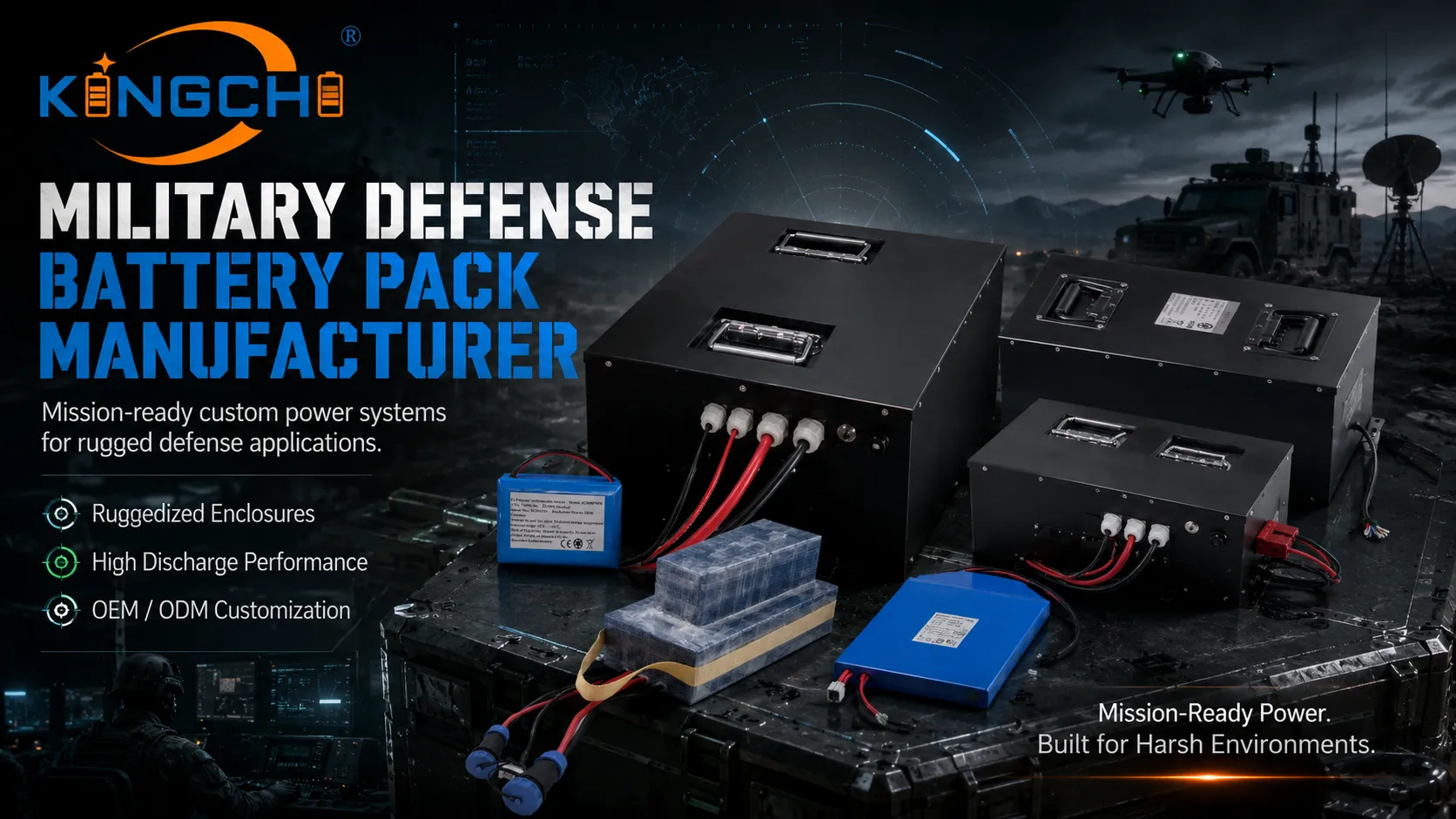
We’ve seen defense program schedules slip by months while procurement teams vet suppliers who can’t pass a security clearance, much less a vibration profile. The wrong military defense battery pack manufacturer doesn’t just fail a test—it adds 12 months of re‑qualification and a budget overrun that nobody planned for. At kingchi, we approach defense power contracts as engineering partnerships, not purchase-order transactions.
We’ve learned that a custom defense battery pack isn’t a collection of off‑the‑shelf cells stuffed into a rugged shell. It’s a system where cell chemistry, battery management system (BMS) architecture, and domestic supply‑chain security must work together from day one. The checklist on your desk can’t afford a gap in MIL-PRF-32383 testing or an ITAR registered battery manufacturer that can’t prove lineage on every cell.
Tactical Applications for Military-Grade Battery Packs
Soldier-Worn and Wearable Power Systems
Reducing the warfighter’s load is a constant priority. Modern dismounted soldiers carry radios, night‑vision devices, and battlefield awareness computers, all demanding reliable military grade batteries that don’t add unnecessary bulk. We prioritize high‑energy‑density cells with minimal voltage sag under pulse loads, because a soldier shouldn’t wonder if their tactical power supply will hold up during a 12‑hour patrol. Enclosures must survive submersion (IP67 minimum) and direct impact, yet stay light enough to avoid fatigue. We often recommend pouch‑cell configurations that contour to a plate carrier or integrate into the small of the back, keeping weight distribution neutral while delivering the Wh/kg that legacy alkaline stacks can’t match.
Unmanned Systems (UAVs, UGVs, and UUVs)
Unmanned platforms push batteries to extremes that commercial packs never see. A Group 2 UAV needs a high discharge rate battery capable of sustaining 10C bursts for launch and climb, then settling into an efficient cruise. At the opposite end, unmanned undersea vehicles (UUVs) require pressure‑tolerant enclosures rated for thousands of meters of depth, where even a tiny cell swelling can become a catastrophic failure. We design for variable buoyancy and cold‑soak starts in near‑freezing seawater, often using 6T lithium battery modules derated for marine pressure and packaged with redundant safety vents. In all unmanned applications, the BMS has to operate autonomously for weeks, reporting state‑of‑charge over CAN bus to a mission computer that rarely tolerates a mid‑sortie reset.
Tactical Communications and Ruggedized Electronics
Secure voice and data links are the backbone of any operation. Radios like the PRC‑152A, PRC‑119, and KY‑57 suites demand PRC152A battery pack solutions that can deliver consistent voltage down to ‑40°C without a heater blanket that steals precious Wh. We’ve seen procurement teams over‑specify C‑rate, driving up cost and volume, when the real requirement is long float life in silent‑watch modes. Our tactical battery packs use smart fuel‑gauging with SMBus communication so the radio can display accurate remaining runtime, eliminating the guesswork that leads to field failures. A BB2590U military battery with integrated state‑of‑health logging lets logisticians replace packs before they degrade, not after they quit.
Military Ground Vehicle Platforms (6T Standard)
The shift from legacy lead‑acid to lithium‑ion in ground vehicle fleets is now a program of record, not a science project. A lithium‑ion 6T lithium battery drops about 40 pounds per unit while doubling usable capacity, but it demands a BMS that can manage 24V and 28V nominal bus voltages while surviving the brutal shock of an MRAP hitting an IED. We stress‑test every vehicle pack to MIL‑STD‑810H vibration profiles, including gunfire shock and ballistic shock, and ensure the battery can cold‑crank a diesel engine after a 72‑hour cold soak at ‑33°C. NATO standardization means physical dimensions are non‑negotiable; the pack must drop into existing battery boxes, so our mechanical engineering starts with the mounting tray, not the cell layout.
Core Military Standards and Safety Certifications to Verify
No amount of datasheet promise replaces an audited test report. We advise procurement teams to treat certifications as a verification checklist, not a marketing line.
| Standard | What It Covers | Why It Matters for Defense |
|---|---|---|
| MIL-STD-810H | Temperature, shock, vibration, humidity, altitude, salt fog, sand/dust | Proves the pack survives the platform’s actual environmental envelope, not just a lab bench. |
| MIL-PRF-32383 | Abuse tolerance, fire propagation, overcharge, forced discharge, bullet penetration | Sets the bar for rechargeable lithium‑ion safety in personnel‑borne and vehicle applications. |
| UN 38.3 | Altitude simulation, thermal cycling, vibration, shock, external short circuit, impact/crush, overcharge, forced discharge | Mandatory for air, sea, and ground transport; logistics chain acceptability starts here. |
Note: Buyers should verify whether test reports come from an ISO 17025‑accredited third‑party lab or an internal facility. Only a witnessed report chain can satisfy most Defense Contract Management Agency (DCMA) audits.
MIL-STD-810: Environmental Engineering Considerations
This isn’t a single test; it’s a family of methods that must be tailored to the platform. For a dismounted radio battery, we’ll apply Method 514.8 (vibration) with a profile that mimics a soldier running with a ruck. For a vehicle pack, it’s the combined wheeled‑vehicle vibration and shock from Method 516.8. The key procurement question is whether the manufacturer can produce a test plan that maps each method to the operational mission, not just a generic “pass/fail” report. A pack that survives 500G mechanical shock on paper but fails during a 20‑hour low‑pressure test at 15,000 ft will ground a UAV without warning.
MIL-PRF-32383: Safety and Performance for Rechargeable Batteries
This performance specification is the most demanding regime for military lithium‑ion packs. It requires nail penetration tests, crush tests, and fire‑propagation containment that commercial UL or IEC standards don’t approach. We tell buyers to pay attention to the pass‑through test: if a single cell goes into thermal runaway, the surrounding cells must not ignite for at least five minutes. That requirement drives material choices, spacing, and vent design. A military defense battery pack manufacturer should be able to show video evidence of these abuse tests, because the engineering decisions that enable a pass are invisible in a finished pack.
UN 38.3: Safe Transport of Lithium-Ion Systems
While UN 38.3 is less rigorous than the military standards above, it remains a non‑negotiable gateway. Every battery cell and pack must be certified before shipping. The T1–T8 tests cover altitude, thermal cycling, vibration, shock, external short, impact/crush, overcharge, and forced discharge. For defense programs, we often see packs shipped by military airlift, which adds extra scrutiny. A manufacturer’s failure to maintain recertification after a design change can freeze an entire shipment at a logistics hub, delaying fielding by weeks.
Evaluating Battery Chemistry and Custom BMS Engineering
Lithium-Ion vs. Lithium Iron Phosphate (LFP) vs. Thermal Batteries
No chemistry dominates across all missions. We help program managers match the cell to the duty cycle, not the glossy brochure.
| Chemistry | Energy Density (Wh/kg) | Thermal Stability | Best For |
|---|---|---|---|
| Lithium Nickel Manganese Cobalt Oxide (NMC) | 200–250 | Moderate; requires active cooling above 55°C | UAVs, manpacks, lightweight soldier systems |
| Lithium Iron Phosphate (LFP) | 90–120 | Excellent; safe to 60°C without thermal runaway propagation | Ground vehicles, large UUVs, stationary tactical power |
| Thermal (Molten Salt) | N/A (single‑use, activated by pyrotechnic) | Extreme; stored inert for decades | Missile guidance, fuze power, one‑shot munitions |
Data represents typical ranges from public cell datasheets; actual performance depends on pack design and BMS limits.
LFP’s lower voltage and flat discharge curve can complicate fuel‑gauging, but its abuse tolerance simplifies logistics in combat. NMC gives a designer more runtime per cubic inch, but the thermal management system becomes a critical path item. A custom military battery pack manufacturer should walk you through the safety case, not just the nameplate capacity.
The Critical Role of a Custom Military Battery Management System (BMS)
Off‑the‑shelf BMS silicon wasn’t designed to make decisions while an electronic warfare suite jams half the spectrum. We build military BMS architectures around the communication protocol the platform demands—typically SMBus for soldier‑worn electronics or CAN bus for vehicle and UAV integration. The BMS has to discriminate between a momentary load spike (like an RF amplifier keying up) and a genuine cell over‑discharge, then isolate the pack without interrupting the mission. We also harden the processor against voltage transients that would latch up a commercial IC, and we epoxy‑coat the board to survive condensation after rapid altitude changes. Every BMS we deliver includes a black‑box data recorder that logs peak currents, minimum voltages, and temperature extremes for post‑mission forensic analysis.
Designing for Active Safety and Cell Balancing
Passive balancing burns off excess energy as heat, which is a non‑starter in a sealed tactical enclosure. We use active balancing circuits that shuttle charge from higher‑voltage cells to lower ones, keeping the entire string within a 15 mV window without generating heat soak. Combined with redundant field‑effect transistor (FET) protection on both charge and discharge paths, the pack doesn’t need a secondary protection board that adds points of failure. In high‑duty‑cycle applications like counter‑UAS jammers, the BMS also enforces dynamic current limits based on real‑time cell temperature, not a conservative fixed cap that leaves performance on the table. This allows a military battery solution to deliver full rated power until the thermal margin is actually consumed, buying the operator extra time when it counts.
Security of Supply Chain and Regulatory Compliance
ITAR Registration and NDAA Compliance
If your battery powers a system on the US Munitions List, the development data is ITAR‑controlled, period. An ITAR registered battery manufacturer that understands the distinction between EAR99 and USML Category XI (military electronics) can work without triggering a technical‑data export violation. We’ve seen programs stall because a foreign‑owned sub‑supplier received a drawing marked “ITAR” in an email. That’s the kind of compliance gap that gets a prime disqualified. NDAA Section 889 compliance is equally critical: no Chinese‑origin components in a battery that will be fielded with a DoD unit. Our procurement process verifies the country of origin at the cell level, and we maintain a documented chain of custody from the cathode powder forward.
Facility Clearance, CAGE Codes, and Secured Domestic Production
A CAGE code defense manufacturer is more than a registration number; it’s a signal that the company has passed a DCMA audit and can handle controlled unclassified information (CUI). For a defense battery pack, that audit extends to storage of technical data and the physical security of the production floor. We recommend that buyers verify the CAGE code’s status and facility clearance level (NISPOM conformant) before sharing performance requirements. Even if the final assembly is done domestically, the cell‑winding machine supplier or BMS firmware developer might fall under a foreign‑ownership disclosure. A military defense battery pack manufacturer that can’t produce a current DD‑254 is a schedule risk.
Cell Sourcing and Secondary-Source Risk Mitigation
Single‑source a cylindrical cell from a single factory, and a production line hiccup becomes your problem. We qualify at least two cell suppliers for every pack program, with form‑fit‑function interchangeability validated through the same MIL‑PRF‑32383 abuse tests. For prismatic and pouch cells, we also maintain a second‑source qualification for the raw electrode stack, so that if a regulatory shift blocks one supplier’s geography, the pack doesn’t go end‑of‑life. This multi‑source discipline adds upfront engineering cost, but it’s the difference between a best military battery pack supplier that can keep your production line running and one that can’t.
Total Cost of Ownership (TCO) and Lifecycle Maintenance in Defense Power
Battery Cycle Life and Fleet Degradation Planning
A 500‑cycle datasheet rating at 25°C doesn’t reflect a pack that lives in a 60°C helicopter avionics bay. We advise logistics managers to model cycle life against the actual temperature‑time profile of the deployment, because every 10°C rise above 25°C halves calendar life. For a fleet of 2,000 vehicle batteries, that means predicting when 10% will fall below 80% capacity and budgeting for a phased replacement. A pack with an integrated cycle counter and SOH (state‑of‑health) over CAN bus feeds that data directly into the maintenance planning system, preventing expensive emergency buys.
Intelligent Chargers and Universal Tactical Power Supplies
A dumb charger will kill a lithium‑ion pack faster than combat damage. Our tactical power supply and charger designs communicate with the pack to adjust voltage, current, and end‑of‑charge based on pack age and temperature. A universal charger platform that can service multiple battery types (6T, BB‑2590, BA‑5390) cuts the logistics footprint and training burden. We build them with wide‑input (85–265 VAC, 47–440 Hz) power supplies and MIL‑STD‑1275/704 transient protection so they can run off a generator anywhere in the world.
Long-Term Storage, Shelf-Life, and Battery Disposal Logistics
Lithium‑ion packs don’t like sitting at 100% state of charge for 18 months. We ship military packs at a controlled 30‑50% SOC and recommend periodic maintenance cycling with a storage‑mode charger. For disposal, the pack must be de‑energized to a transport‑safe voltage and fully documented with hazardous‑material shipping paperwork. A BA-5390U military battery that reaches end‑of‑life shouldn’t become a logistics headache; we design in removable bus bars and clearly marked discharge terminals to speed the process.
Key Procurement Criteria for Selecting a Battery Manufacturing Partner
Prototyping Capabilities and Fast-Track Engineering
When a program office needs a functional prototype in 60 days, the manufacturer’s in‑house tooling and simulation capability determines whether that deadline is realistic. We’ve delivered fully functional battery packs with production‑equivalent BMS firmware in under eight weeks by maintaining a library of pre‑qualified cell stacks and modular enclosure tooling. Ask potential partners how many military grade batteries they’ve prototyped in the last 12 months and what rapid‑prototyping processes (3D‑printed enclosures for EMI shielding validation, for example) they use before cutting aluminum. A specialized military battery pack vendor that can’t explain its design‑freeze checklist isn’t ready for prime contractor timelines.
High-Volume Production Scalability and Quality Control
Prototyping ten packs is one skill; producing 5,000 with zero lot failures is another. We use automated cell sorting, laser‑welded interconnects, and automated optical inspection (AOI) of every weld joint to maintain first‑pass yield above 99.5%. An AS9100‑certified quality management system isn’t optional for defense work, and we expect buyers to ask for a copy of the quality manual, not just the certificate. Statistical process control on capacity, impedance, and self‑discharge catches cell drift before it becomes a field failure.
Custom Enclosure and Mechanical Ruggedization Engineering
Dust, water, and ballistic shock don’t care about your IP rating unless the seals are validated after 1,000 connector mate/demate cycles. We design custom enclosures with dual‑shot overmolded gaskets that maintain IP68 integrity even after repeated vibration exposure. When weight is critical, we use machined 6061‑T6 aluminum with hard anodize; when cost is the driver, glass‑filled nylon with EMI‑shielded coatings works. A custom defense battery pack has to survive a Hellfire missile exhaust plume or a sudden salt‑water immersion, and the enclosure is the first line of defense.
Request a Custom Military Battery Technical Consultation
Before you initiate an RFQ, gather your power, envelope, and weight (SWaP) constraints along with the operational temperature range and any known MIL‑STD test profiles. We’ll pair you with an application engineer who can quickly evaluate cell chemistry trade‑offs and BMS architecture. Whether you need a drop‑in replacement for a legacy 6T lithium battery or a guided missile battery that must survive 20,000G setback, our team has worked those problems. Contact us with your draft specification and we’ll return a compliance matrix, a feasibility assessment, and a rough timeline—no marketing fluff, just engineering.
Frequently Asked Questions
What is the significance of a CAGE code for a defense battery manufacturer?
A Commercial and Government Entity code is a unique identifier assigned by the Defense Logistics Agency, proving the manufacturer is a validated entity eligible for DoD contracts and able to receive controlled technical data.
What is the 6T battery standard in military vehicles?
The 6T form factor is NATO’s standardized battery size for ground vehicles, now increasingly adopting lithium‑ion chemistry to cut weight, boost capacity, and improve cold‑starting performance over legacy lead‑acid.
How does MIL-PRF-32383 differ from commercial battery standards?
MIL‑PRF‑32383 mandates extreme abuse tests such as bullet penetration, crush, and fire propagation containment that no commercial standard requires; it validates the battery’s survival in combat, not just a consumer electronics warranty.
Why is ITAR compliance mandatory for military battery projects?
Battery systems designed for defense articles on the US Munitions List are controlled under ITAR; any technical data exchange must follow strict protocols to prevent unauthorized export of military‑sensitive technology.
Can commercial lithium cells be safely modified for tactical military use?
Commercial off‑the‑shelf cells can be integrated into military packs if rugged enclosures and a custom BMS address shock, thermal, and EMI threats, but the resulting assembly must still pass full MIL‑PRF‑32383 qualification.
Frequently Asked Questions

Get a Fast, Custom Power Quote



 English
  Turkish
  Arabic