The Complete UN38.3 Battery Certification Guide: Process, Tests & Costs – Kinghci
Did you know that shipping a lithium battery without UN38.3 certification can result in fines of up to $50,000 per violation and grounded shipments? For B2B buyers, this isn’t just a technical hurdle—it’s a critical supply chain risk.
We see companies face devastating logistics bottlenecks because their documentation fails customs inspection or their packs rupture during regulatory testing. A robust regulatory strategy prevents these issues before production begins, ensuring your products move safely through global distribution networks.
- Understanding the 8 core transport safety tests.
- Compiling the mandatory safety and shipping documentation.
- Optimizing the battery design to pass testing on the first run.
What is UN38.3 Certification? (The Mandatory Baseline)
Why UN38.3 is Non-Negotiable for Shipping: A UN38.3 Battery Certification Guide Perspective
UN38.3 refers to Section 38.3 of the UN Manual of Tests and Criteria, which establishes the global safety standard for shipping lithium cells and packs. No matter if your products travel by air, sea, road, or rail, they must pass these rigorous tests before leaving the factory.
As a leading battery manufacturer, we ensure that every lithium chemistry we process undergoes this baseline verification. Without this battery sourcing guide standard, cargo carriers will legally refuse your shipment, and customs authorities can seize your entire inventory.
- Air Freight: Governed strictly by the IATA Dangerous Goods Regulations (DGR), which mandate UN38.3 for all air cargo.
- Ocean Freight: Regulated by the International Maritime Dangerous Goods (IMDG) Code to prevent thermal events at sea.
- Land Transport: Subject to regional agreements like the ADR in Europe and PHMSA regulations in North America.
UN38.3 vs. Other Battery Certifications (UL, IEC, CE)
B2B procurement managers frequently confuse shipping certifications with product safety standards. While UN38.3 certifies that a battery can safely withstand environmental stresses during transit, it does not guarantee electrical safety during end-user operation.
For example, battery products require IEC 62133 compliance to certify cell and pack safety for portable applications, while UL standards validate safety against internal short circuits under specific loads. Before we configure our battery solutions, we map out both regulatory paths.
| Certification Standard | Primary Focus | Regulatory Mandate | Key Application Space |
|---|---|---|---|
| UN38.3 | Transport environmental/mechanical safety | Global legal requirement (IATA/IMDG) | All shipping, cargo, and logistics |
| IEC 62133 | Portable device battery safety | Market access (EU/International) | Consumer electronics, medical devices |
| UL 2054 / UL 1642 | Pack-level / Cell-level abuse safety | North American market preference | Industrial tools, appliances, EVs |
Data sources: Kingchi regulatory division comparative analysis (2025) and IEC safety compliance standards.
The 8 Critical UN38.3 Tests (T1-T8) Explained
T1-T6: The Core Tests for All Cells & Batteries
To comply with global lithium battery testing standards, cells and packs must survive a battery of mechanical, thermal, and electrical abuses. These battery transport safety tests simulate the worst-case conditions of transit, from unpressurized cargo holds to extreme mechanical vibrations.
Each of the core tests from T1 to T6 targets specific physical and chemical failure modes within the battery assembly. For instance, high-altitude transit exposes weak welds, while mechanical shock challenges the internal cell connections of complex AGV battery packs.
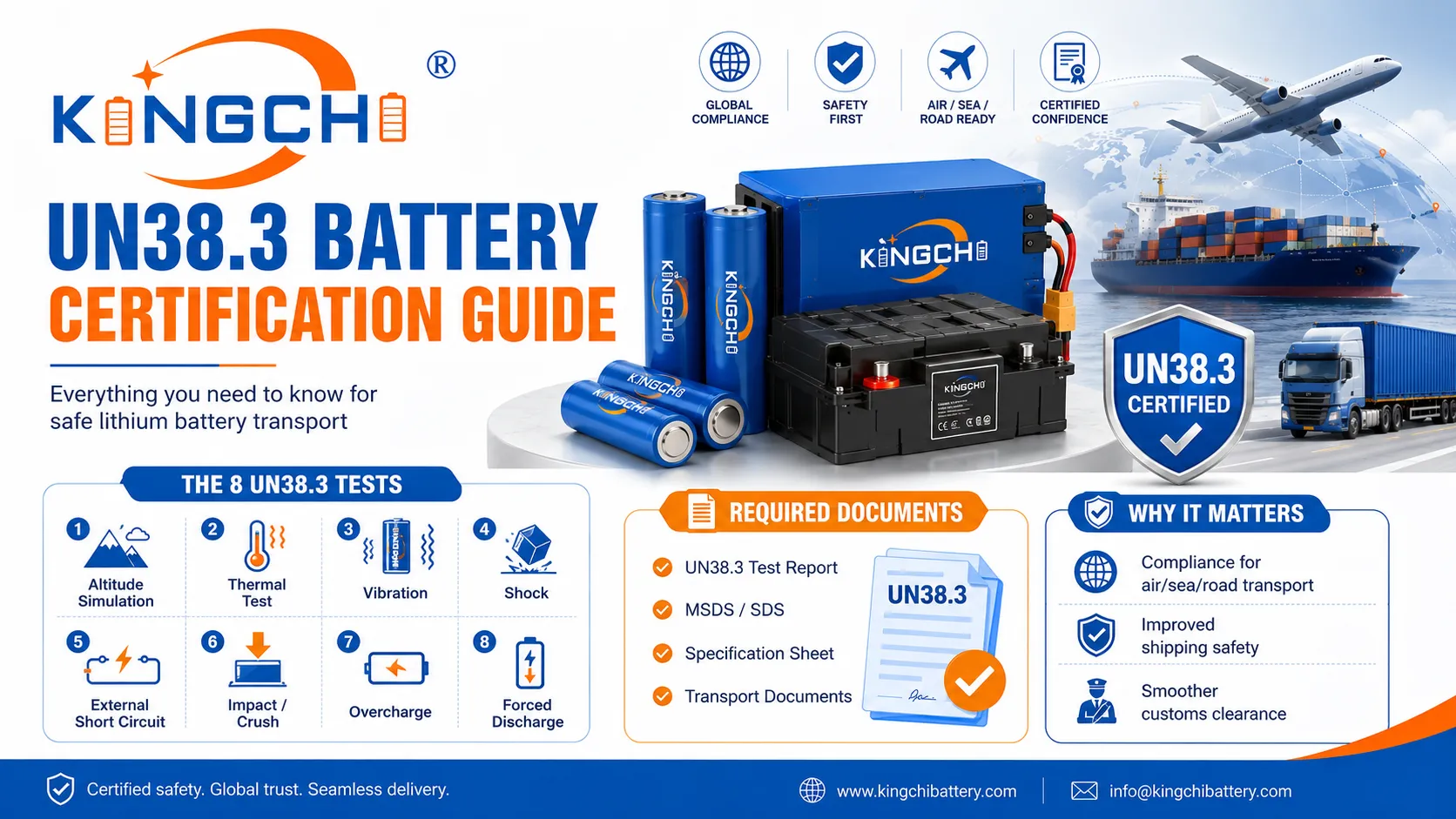
- T1: Altitude Simulation: Simulates unpressurized aircraft cargo holds at 11.6 kPa for 6 hours; measures voltage and mass loss.
- T2: Thermal Test: Cycles cells/packs between -40°C and +72°C; ensures structural integrity under rapid thermal expansion.
- T3: Vibration Test: Subject to sinusoidal vibration (7Hz to 200Hz) for 9 hours; prevents mechanical fatigue of tabs.
- T4: Shock Test: Applies acceleration pulses up to 150gn; tests ruggedness of mounting brackets and welds.
- T5: External Short Circuit: Short-circuits the battery at 57°C; ensures the BMS or internal fuses prevent thermal runaway.
- T6: Impact/Crush: Mechanically deforms the cell using a heavy weight or hydraulic press; simulates crushing during cargo handling.
T7 & T8: Overcharge & Forced Discharge
Unlike the core mechanical trials, T7 and T8 evaluate the electrical protection systems under extreme over-demand. The T7 test is only applicable to rechargeable systems, ensuring the battery management system (BMS) successfully shuts down over-current before a thermal event occurs.
We design our custom lithium battery packs with redundant protection layers to guarantee T7 compliance. T8 forces a fully discharged cell into a reverse-polarity state, testing its resilience against internal cell shorting during deep discharge cycles.
The UN38.3 Certification Process: A Step-by-Step Roadmap
Step 1: Pre-Test Preparation – Gather Your Samples & Documentation (UN38.3 Battery Certification Guide)
The biggest bottleneck in any testing program is entering the lab with incomplete documentation or too few samples. Depending on the pack size and configuration, you will need to provide between 8 and 16 cell samples, and up to 8 fully assembled battery packs.
We always recommend compile-ready documentation before shipping samples to the lab. This includes the technical specifications of your lithium ion cells, complete wiring schematics, BMS data sheets, and preliminary MSDS documents.
- Cell samples: Typically 10 to 18 cells, depending on whether they are primary or rechargeable.
- Pack samples: Usually 4 to 8 finished packs, fully charged and ready for cycling.
- Documentation: Detailed chemistry profiles, BMS specifications, and safety parameters.
Step 2: Selecting a Certified Testing Lab
Not all test facilities are created equal, and choosing an unaccredited lab can invalidate your results with strict customs agents. Look for labs with ISO/IEC 17025 accreditation and direct recognition from global regulatory bodies.
When studying our battery sourcing guide, pay close attention to lab partnerships. Working with premium entities like Intertek, TÜV SÜD, or SGS ensures your certifications are accepted without question at any international border.
- Verify the lab’s ISO 17025 scope covers lithium battery transport safety tests specifically.
- Check if they provide a standardized Test Summary format.
- Confirm their average queue times, which can dramatically impact your shipping schedules.
Step 3: The Testing Phase – What to Expect
Once your samples arrive, the lab runs them sequentially through tests T1 to T8 over a span of several weeks. If any single cell or pack experiences leakage, venting, disassembly, rupture, or fire, the entire series fails.
In our experience, structural failures in high-vibration applications or thermal runaways during overcharge are the most common failure points. Passing this phase is especially critical for specialized UAV batteries that operate under intense stress.
- Testing Duration: Typically ranges from 4 to 6 weeks depending on laboratory backlog.
- Failure Action Plan: Root-cause analysis, mechanical or BMS modification, and a complete retest sequence.
Step 4: Receiving Your Certificate & Test Summary (UN38.3 Battery Certification Guide)
Once testing is complete, you will receive a comprehensive test report detailing each test’s raw data and observations. However, carriers do not want to parse a 50-page technical document; they require a concise Test Summary.
This document is a standardized, single-to-double-page document certifying that your specific configuration complies with all shipping regulations. It must be made readily available to all distributors and freight forwarders in your supply chain.
Engineering for Compliance: Designing Your Battery Pack to Pass UN38.3
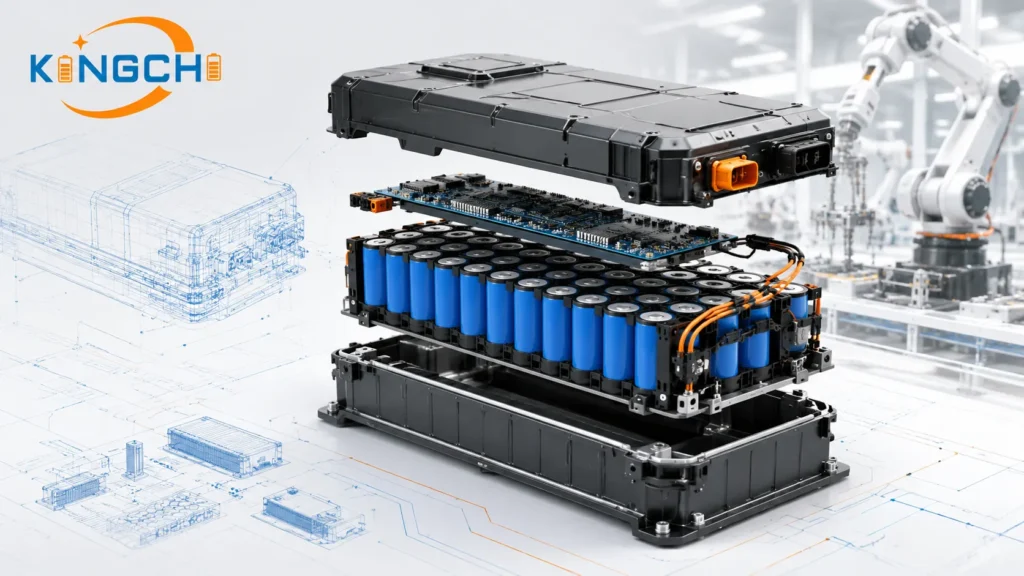
Designing a battery pack that passes certification on the first try requires deep engineering foresight. As an experienced custom battery pack manufacturer, we have refined our designs to survive these mechanical and electrical trials.
The most cost-effective strategy is to start with cells that are already certified. If the base cell has already passed T1-T6 and T8, the finished pack testing is streamlined, primarily requiring only T7 overcharge testing.
- BMS Optimization: We program dual-level overvoltage and short-circuit protections to isolate the cells before physical limits are breached.
- Vibration Dampening: We use precision-molded cell holders, flame-retardant structural adhesives, and localized potting to isolate joints from T3 vibration forces.
- Thermal Isolation: We design packs with adequate spacing and physical thermal barriers to ensure localized cell thermal events do not propagate.
If you are developing a product that requires robust compliance, choosing a manufacturing partner who understands these design rules is essential. We work alongside your engineering team to ensure the mechanical housing, nickel welding pattern, and wire routing are optimized for high-vibration transit environments.
Our engineering team coordinates the entire process, minimizing your technical risks and preventing costly delays during the export phase. By selecting Kingchi as your partner, you leverage certified cells and a proven design template.
UN38.3 Battery Certification Guide: Costs & Timelines
B2B buyers frequently underestimate both the cost and the timeline required to achieve compliance, leading to missed launch windows. Preparing a realistic budget requires factoring in not just lab fees, but also shipping, engineering, and sample destruction costs.
When developing custom specialized battery packs, the certification costs vary significantly based on pack complexity, weight, and chemistry. We break down these costs to help procurement managers draft accurate budgets.
| Cost Category | Estimated Range (USD) | Key Driver | Timeline Impact |
|---|---|---|---|
| Standard Lab Testing Fees | $4,500 – $8,500 | Pack size, weight, voltage, and lab queue times. | 3 – 6 weeks |
| Sample Cells and Packs | $1,000 – $4,000 | Material costs for destructive testing samples. | 1 – 2 weeks (Production) |
| Hazardous Shipping & Logistics | $500 – $1,500 | Transit fees to send non-certified prototypes to the lab. | 1 – 2 weeks |
| BMS Tuning and Retesting | $2,000 – $5,000 | Required only if a failure occurs during T5 or T7. | Add 2 – 4 weeks |
Data sources: Kingchi engineering compliance data and third-party partner lab estimates (2025).
To reduce these costs, we highly recommend a “family certification” approach when designing similar battery models. If multiple packs use the same cells, identical BMS protection limits, and similar enclosure designs, some labs allow certifying them under a single “family” report, saving thousands of dollars.
Mastering the Paperwork: MSDS, Test Summaries & Your Compliance File
Passing the physical tests is only half the battle; maintaining a flawless compliance folder is what prevents delays during international shipping. Standard customs clearances require both an up-to-date Safety Data Sheet (SDS/MSDS) and a formalized Test Summary.
Strict MSDS documentation requirements mandate that the safety sheet must detail the exact chemical composition of the battery, along with spill response protocols and fire safety details. Our compliance team maintains active, updated SDS sheets for all our battery solutions.
- Unique Test Summary Number: A traceable ID linking back to the original laboratory report.
- Cell or Battery Parameters: Detailed descriptions of the battery type, mass, and Watt-hour (Wh) rating.
- Completed Tests List: Verification that T1 through T8 were executed successfully.
- Manufacturer Contact: Accurate physical address, telephone number, and official email of the manufacturer.
We advise keeping these files in a centralized digital compliance folder accessible to your logistics coordinators and logistics providers. When a carrier like DHL or FedEx requests verification, providing a 2-page Test Summary instead of a 100-page laboratory report speeds up clearance significantly.
Furthermore, ensure your charging accessories match regulatory parameters. Using certified battery chargers guarantees that the electrical properties tested during UN38.3 match real-world field applications perfectly.
Frequently Asked Questions About UN38.3
Is UN38.3 certification required for all lithium batteries?
Yes, global transport regulations mandate UN38.3 testing for almost all lithium-metal and lithium-ion cells and batteries shipped by air, sea, road, or rail. This applies to individual cells, batteries integrated into equipment, or batteries packed with equipment. There are extremely limited exceptions, typically only for prototypes or low-volume runs under strict regulatory permission and specialized packaging.
How long is a UN38.3 certificate valid?
A UN38.3 certificate does not have an official expiration date, but it is valid only as long as the battery design remains unchanged. Any modification to the battery chemistry, physical dimensions, internal cell configurations, structural enclosure, or BMS electrical safety limits requires re-evaluation or complete re-testing to maintain compliance.
Can I use a supplier’s UN38.3 certificate for my own battery pack?
No, you cannot. Even if you use cells that already possess individual UN38.3 certificates, the final assembled battery pack constitutes a new product and must undergo its own pack-level UN38.3 testing. This is because the assembly introduces new mechanical joints, wiring, and a BMS, all of which must be separately validated for transport safety.
What happens if my battery fails a UN38.3 test?
If a failure occurs, the lab stops the test sequence, and you must conduct a detailed root-cause analysis (such as analyzing a BMS failure during overcharge or mechanical weld breaks during vibration). After identifying the defect, the engineering team must modify the battery design, build new samples, and submit them for a retest, which adds to both the overall budget and the development timeline.
What is the difference between a UN38.3 Test Report and a Test Summary?
A Test Report is a highly detailed, multi-page technical document issued by the laboratory that contains raw test data, voltage measurements, and full environmental chamber logs. In contrast, a Test Summary is a standardized, concise document (typically 1 to 2 pages) containing ten mandatory identification points that must be provided to logistics providers and customs officials upon request.
Do I need UN38.3 if I already have UL 1642 certification?
Yes. UL 1642 is a product-level safety standard that certifies individual cell safety against electrical and fire hazards under normal operating conditions. UN38.3 is a strict transit safety standard focused on mechanical and environmental stresses encountered specifically during shipping; you must have both to legally ship and market your battery pack globally.
Frequently Asked Questions

Get a Fast, Custom Power Quote


 English
  Turkish
  Arabic