Lithium Battery Testing Standards: Cell vs. Pack-Level Guide
Most lithium battery testing standards procurement delays we see at kingchi don’t come from bad cells. They come from compliance teams applying pack-level standards to bare cells — or certifying a cell to IEC 62133-2 but forgetting that the US still requires UL 1642 before the pack enters a distribution center. Get the entry point wrong, and you’ll either pay for redundant testing or watch your shipment sit in customs.
That’s the reality we help hardware engineering managers, sourcing leads, and compliance officers navigate every week. This guide maps the exact testing pathways — from cell-level abuse to full-pack transport and industrial installation — so you can select the right standards, avoid retesting traps, and move product into global markets faster.
The Global Landscape of Lithium Battery Testing Standards
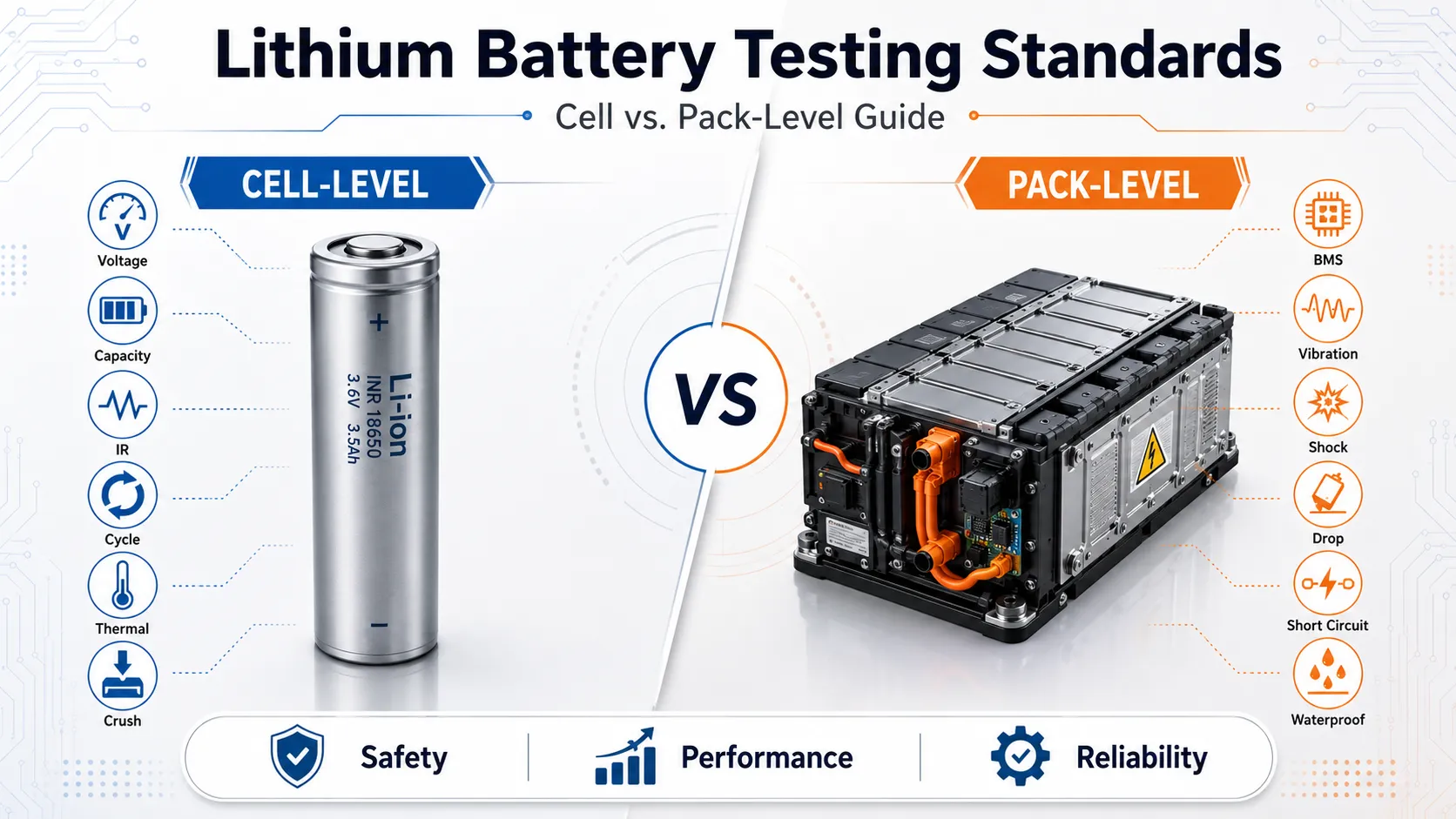
Lithium battery compliance is split between cell‑level standards that evaluate baseline electrochemical safety and pack‑level standards that assess the integration of multiple cells, the enclosure, and the battery management system. Selecting the wrong entry point doubles certification costs and delays time‑to‑market.
Cell-Level vs. Pack-Level Testing
We treat cell-level standards as passive safety validation. A certified cell has proven it won’t internally short, vent uncontrollably, or ignite under the worst single-cell fault conditions. But a pack-level standard validates the active safety layer — the BMS that catches overcharge, the mechanical enclosure that survives a drop, and the interconnects that won’t arc under high‑current faults. If you only have a cell‑level test report and think that satisfies a product‑level regulation, a customs officer will reject the shipment. The same mistake appears when an engineering team submits a UL 2054‑certified pack to a European notified body expecting it to automatically satisfy IEC 62133-2. It doesn’t.
Harmonizing Regional and Global Regulatory Frameworks
The key international bodies — IEC globally, UL in the US, and EN standards adopted by Europe — share common test methods but impose different documentation and national deviation requirements. For example, both UL 1642 and IEC 62133-2 include forced internal short‑circuit testing, but the pass criteria and report format differ enough that one certificate will not directly substitute for the other without a formal conversion pathway such as the IECEE CB Scheme. We advise mapping your physical product architecture before choosing a testing pathway. Identify whether you need cell certification alone (for bare cells sold to pack integrators), pack certification (for assemblies with a protection circuit), or transport certification (mandatory regardless of end‑application).
| Standard | Scope | Primary Market | Application | Mandatory? |
|---|---|---|---|---|
| UN 38.3 | Cell & Pack (transport) | Global | All lithium batteries | Yes — for transport |
| IEC 62133‑2 | Cell & Pack | International (EU, Asia) | Portable devices | Market‑driven / required for CE marking |
| UL 1642 | Cell only | United States | Cells for portable packs | Not legally mandatory; buyer‑expected |
| UL 2054 | Pack only | United States | Portable battery packs | Buyer‑expected for NRTL listing |
| IEC 62619 | Cell & Pack | International | Industrial & stationary | Market‑driven / required for many installers |
| UL 1973 | Pack & System | North America | Energy storage systems | Buyer‑expected for utility interconnection |
Note: “Global” for UN 38.3 refers to all ICAO/IATA/IMO member states. Regional certifications may still be needed for product safety approval, even with a valid UN 38.3 report.
UN 38.3: The Mandatory Transportation Safety Baseline
UN 38.3 is a non‑negotiable global transit standard requiring lithium batteries to survive eight severe physical stress tests simulating transportation hazards. No commercial lithium battery pack can legally ship — even from a component factory to an OEM warehouse — without an active UN 38.3 Test Summary report.
The Eight UN 38.3 Transport Safety Tests
The UN Manual of Tests and Criteria, Section 38.3 prescribes eight sequential “T‑tests” that a battery must pass without leakage, venting, disassembly, rupture, or fire. We see too many procurement teams treat these tests as a formality, but they expose serious integration weaknesses.
- T1 Altitude Simulation: 6 hours at 11.6 kPa (simulating 15,000 m) — checks for electrolyte leakage from pressure differential.
- T2 Thermal Test: 72‑hour cycle between ‑40°C and +75°C — exposes seal integrity and material mismatches.
- T3 Vibration: Sinusoidal sweep 7–200 Hz, up to 8 g — replicates truck and air freight vibration profiles.
- T4 Shock: 150 g peak for 6 ms in three axes — simulates severe handling impacts.
- T5 External Short Circuit: ≤0.1 Ω for at least 1 hour at +55°C — validates current‑interrupt devices.
- T6 Impact/Crush: 9.1 kg mass dropped from 61 cm onto a bar across the cell — single‑point stress for prismatic or cylindrical cells.
- T7 Overcharge: Twice the manufacturer’s recommended maximum charge current — checks pack‑level protection.
- T8 Forced Discharge: 1C reverse current applied to a fully discharged cell — only for cells intended for multi‑cell packs.
For cells tested at the cell level, the report must be clear that it’s a cell‑level test; for packs, the integrated assembly is tested as shipped. A common error we catch is a supplier submitting a cell‑level UN 38.3 when the commercial product is a multi‑cell pack with a BMS that could alter overcharge behavior.
Shipping Compliance and Logistics Strategy
What to verify: That the supplier provides a UN 38.3 Test Summary document as required by UN38.3 Section 38.3.5 — not just a generic UN38.3 certification. The test summary must list the specific cell and battery models, the testing laboratory details, and the report number. A certificate of conformity without a linked test report is insufficient for air carriers, and you risk cargo impoundment, carrier blacklisting, and environmental liability. For prototypes, custom packs can qualify for UN 3480 / UN 3481 exemptions under specific packaging instructions, but you still need baseline transport safety evidence. We urge logistics teams to verify the test summary’s issue date, confirm the laboratory is ISO/IEC 17025 accredited for UN 38.3, and check that the battery’s state of charge for testing matches the report conditions.
Commercial Portables: Comparing IEC 62133-2, UL 1642, and UL 2054
For portable and handheld B2B applications, IEC 62133‑2 serves as the dominant global standard for secondary lithium‑ion cells and packs, while the US market relies on UL 1642 for individual cells and UL 2054 for complete battery pack assemblies.
IEC 62133-2: The International Standard for Portable Applications
IEC 62133‑2 applies to small‑format rechargeable lithium‑ion cells and packs used in portable electronics, medical devices, power tools, and similar gear. It covers both cell‑level abuse tests (e.g., forced internal short circuit, thermal abuse) and pack‑level system tests (e.g., overcharge, external short circuit, drop test). The current edition tightens pass/fail criteria for fire and explosion, and requires that the cell’s operating region — voltage, current, temperature — be declared and verified. When a pack manufacturer sources a cell certified to IEC 62133‑2 and integrates it with a compliant BMS, the finished pack can be tested to the same standard, often with reduced duplication if the test lab accepts the cell certificate.
Decision rule: If your product is destined for the European market, IEC 62133‑2 is the most direct route to CE marking and satisfies the safety requirements of the applicable EU directives. The US counterpart UL 62133‑2 exists, but few US buyers accept it as a substitute for NRTL listing without additional UL 2054 evaluation.
UL 1642 vs. UL 2054: The United States Dual-Layer Approach
The US framework deliberately separates cell and pack evaluation. UL 1642 is a cell‑only standard that includes aggressive destructive tests: crush, impact, shock, vibration, heating, temperature cycling, external short circuit, and abnormal charging. It assumes no protective electronics are present, making it a stringent materials‑level safety screen. UL 2054 then builds on that cell foundation and tests the complete pack under fault conditions: short circuit, abnormal charging, abusive overcharge, and component fault simulation. The protection circuit must interrupt hazardous conditions before the cell reaches thermal runaway.
Engineering takeaway: If you are a pack integrator selling into the US, your cell supplier’s UL 1642 report is not a pack safety certificate. You must still submit the assembled pack for UL 2054 testing (or an appropriate NRTL listing) unless the end customer explicitly waives the requirement — which is rare in medical and industrial supply chains. We frequently see sourcing teams mistakenly assume a UL‑recognized cell automatically makes the pack UL‑listed.
Industrial Systems and Grid Energy Storage: IEC 62619 and UL 1973 Compliance
Large‑scale industrial and utility applications bypass portable battery standards entirely, requiring compliance with IEC 62619 (internationally) or UL 1973 (in North America) to mitigate thermal runaway propagation in high‑capacity installations.
IEC 62619: Safety for Industrial and Stationary Applications
IEC 62619 addresses high‑capacity lithium cells and battery packs for stationary energy storage, telecom backup, industrial trucks, and similar heavy‑duty uses. It mandates functional safety evaluation of the battery management system standards — the BMS must be assessed to confirm it maintains voltage, current, and temperature within safe limits even under single‑fault conditions. The standard includes propagation testing: after triggering thermal runaway in one cell, the design must prevent cascading failure to adjacent cells for a defined observation period. In our experience with industrial battery standards, IEC 62619 is the minimum that warehouse and logistics OEMs require for automated guided vehicle packs.
UL 1973: Standards for Energy Storage Systems
UL 1973 covers battery packs and complete energy storage systems for stationary applications, including photovoltaic storage and commercial backup banks. It requires evaluation of fire containment, electrical insulation, and the ability to withstand simulated internal faults without fire or explosion. Unlike portable standards, UL 1973 expects the BMS to be evaluated as a safety‑critical component, and it typically requires a production‑line test plan. Best‑fit scenario: If you’re integrating lithium‑ion racks into a utility‑interconnected storage container in North America, UL 1973 certification and the companion UL 9540 system listing are prerequisites for permitting and insurance. The gap between testing a small 48V telecom bank to IEC 62619 and a megawatt‑scale ESS to UL 1973 is enormous in scope and cost, and we advise teams to budget for multiple months of testing and failure analysis.
Core Laboratory Test Methods: Electrical, Mechanical, and Thermal Stress
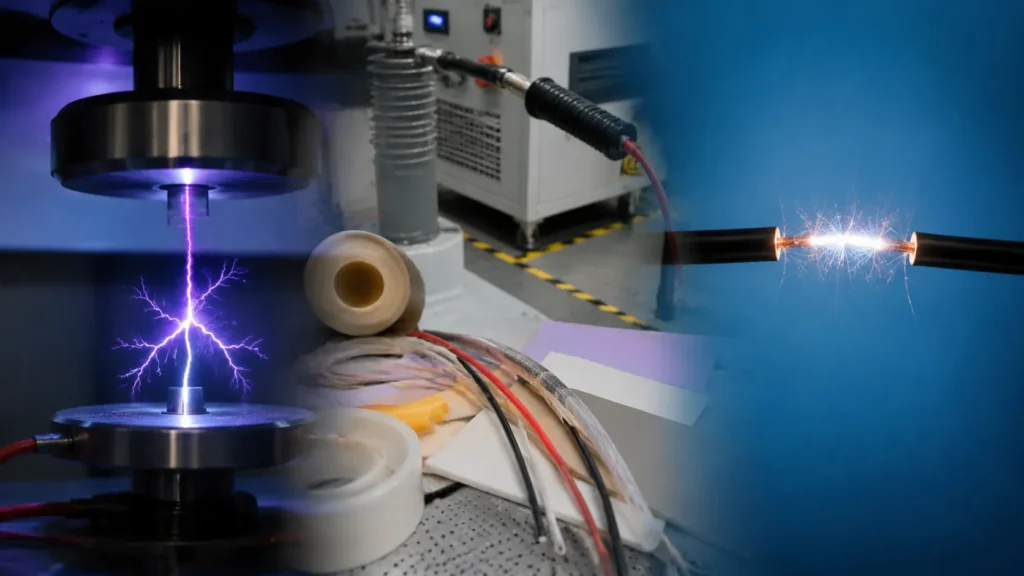
To secure safety certification, lithium batteries must undergo rigorous destructive testing inside specialized chambers, simulating worst‑case electrical anomalies, crushing physical forces, and extreme temperature swings without venting or catching fire.
Electrical Abuse: Overcharge and External Short Circuit Testing
In overcharge testing, a fully charged pack is forced to continue charging at twice the manufacturer’s maximum specified current until the protection circuit or cell venting occurs. The engineering goal is not to prevent eventual cell failure — that’s nearly impossible — but to ensure the failure happens gracefully, without fire. External short circuit testing connects the battery terminals through a ≤100 mΩ load, and the protection device (PTC, fuse, or BMS MOSFET) must interrupt the fault before the cell skin temperature reaches the thermal runaway threshold. For high discharge rate testing, we often evaluate margin: a pack rated for 20 A continuous may need to survive a short‑circuit peak that the BMS can’t immediately interrupt, so conductor sizing and internal resistance become critical.
Mechanical Stress: Crush, Impact, and Vibration Compliance
Mechanical tests validate the enclosure and internal fixturing. Vibration profiles typically sweep 7–200 Hz with up to 8 g acceleration across three axes, mirroring heavy‑truck transport spectra. Impact and crush tests apply concentrated loads: for example, a 9.1 kg bar dropped from 610 mm onto a cylindrical cell, or a 13 kN ±1 kN crush force applied across the cell body. We’ve seen enclosures crack at mid‑span because the internal cell retention design didn’t distribute the crush load. Certification labs also run mold‑stress thermal abuse tests — exposing the plastic housing to elevated temperatures while under load — to verify that it won’t soften enough to expose live conductors. Low‑temperature resilience matters too; temperature performance standards should confirm that the housing material doesn’t become brittle and that the cell can still deliver required current after cold soak.
Global Certification Strategy: CB Scheme, National Deviations, and Retesting Triggers
Navigating global market entry efficiently requires utilizing the IECEE CB Scheme to transfer test results across member nations, combined with a strict product change control process to determine when modifications trigger mandatory recertification.
Leveraging the IECEE CB Scheme for Global Access
The IECEE CB Scheme is a multilateral arrangement among over 50 nations. A test performed by a recognized CB testing laboratory (CBTL) is issued with a CB test certificate that national certification bodies can use to issue their own local marks without repeating the full test suite. This streamlines market access for medical devices, industrial tools, and consumer electronics that must satisfy both EU and Asian safety requirements. However, each country can impose “National Deviations” — additional requirements layered on top of the base IEC standard. For instance, some countries demand specific fuse types, extra insulation spacing, or unique warning labels. A CB certificate that doesn’t account for national deviations can still result in a refused customs entry. We advise working with a laboratory that actively maintains a global deviations matrix for your target countries.

Retesting Triggers for Battery Design Changes
Buyer warning: Minor engineering changes often force a full retest cycle. Based on our experience helping teams manage certification logistics, here are the modifications that most frequently trigger mandatory re‑evaluation:
- Changing the cell supplier or cell model, even if the datasheet looks identical.
- Modifying active cathode or anode material chemistry within the same cell format.
- Altering the enclosure dimensions, venting geometry, or flame‑retardant material grade.
- Updating BMS firmware that changes safety‑related thresholds (overcharge cutoff voltage, short‑circuit trip point, cell‑temperature limits).
- Switching wire gauges in the main power path or replacing connectors with different current ratings.
If any of these occur, your existing test reports become invalid for the modified configuration. We recommend implementing a product change notification workflow that flags every bill‑of‑materials revision against the certified baseline before release.
B2B Sourcing Checklist: How to Verify Battery Test Reports and Compliance Certificates
B2B procurement teams must establish a rigorous verification protocol for all incoming battery specifications, ensuring that supplier‑provided test certificates match the actual cell model and originate from an accredited ISO/IEC 17025 laboratory.
Technical Checklist for Battery Compliance Verification
We teach our sourcing partners to walk through this sequence for every new battery supplier:
- Confirm that the test report lists the exact cell or pack model identifier shown on the cell datasheet and on the physical label — not a series family or generic part number.
- Check the certificate issue date and verify that the testing standard edition matches the current revision (for example, IEC 62133‑2:2017+AMD1:2021, not the obsolete 1st edition).
- Verify that the issuing laboratory holds active ISO/IEC 17025 accreditation with the specific standard in its scope — look it up on the laboratory’s official accreditation database, not just the certificate.
- Ensure the test report includes all technical parameters: cell operating voltage range, maximum charge current, temperature limits, and the BMS protection thresholds against which the pack was evaluated.
- Cross‑check that the test report number matches the number on the official UN 38.3 Test Summary or CB certificate — a mismatched reference is a common sign of document reuse.
Spotting Red Flags in Supplier-Provided Documentation
Too often we see procurement teams accept a single PDF from a supplier without scanning for these danger signals:
| Red Flag | What It Could Mean | Buyer Action |
|---|---|---|
| Test report dates older than 3 years and not revalidated | Standard edition may be retired; cell design may have changed | Request re‑test or re‑evaluation letter from the lab |
| Certificate of Conformity from an unknown or unaccredited body | No regulatory acceptance; customs rejection risk | Verify lab accreditation; reject if not ISO/IEC 17025 with scope |
| Test report omits the cell’s operating region limits | Incomplete testing; pack may not be evaluated at actual use conditions | Require full parameter declaration; source from manufacturer testing standards that include those limits |
| UN 38.3 document labeled “certificate” without a valid Test Summary | Does not meet UN38.3 Section 38.3.5; carrier may reject | Insist on the official Test Summary with report number, lab details, and cell/pack identification |
Note: Always confirm that the testing laboratory was ISO/IEC 17025 accredited for the specific standard at the time of testing. Accreditation scope can change annually.
Selecting an Accredited Partner for Your Lithium Battery Testing
Successfully launching a lithium‑powered product requires partnering early with a globally recognized, ISO/IEC 17025 accredited testing laboratory that possesses deep expertise in global market access. Waiting until after the mechanical design is frozen is the costliest mistake we see. Instead, we advise engineering managers and sourcing leads to review their current design schematics, cell selections, and target market list with a testing advisor before finalizing the physical build. Prepare the following before contacting a lab: specific battery chemistry and cell data sheets, pack configuration (series/parallel architecture), expected BMS functional characteristics, target regulatory markets (US, EU, China, etc.), and approximate production scale. An experienced partner can then map the test plan, identify national deviations early, and schedule testing in a sequence that avoids redundant conditioning cycles. For teams evaluating lithium battery pack testing requirements, kingchi’s technical staff can help clarify which standards apply to your architecture and market footprint. If you’re sourcing tested battery solutions or developing industry‑specific testing strategies, connecting early reduces time‑to‑market and customs risk.
Frequently Asked Questions
What is the difference between IEC 62133-2 and UL 1642?
IEC 62133‑2 is an international standard covering both cells and packs for portable devices, whereas UL 1642 is a US‑centric standard strictly for cell‑level testing. A UL 1642 certified cell is often a stepping stone to achieving UL 2054 or IEC 62133‑2 pack certification, but it does not replace pack‑level evaluation.
Is UN 38.3 certification mandatory for prototype battery assemblies?
Yes. Transit regulations apply to all shipments of lithium batteries, including prototype packs and engineering samples. Custom prototype shipments may qualify for specific exemptions under packaging instructions such as UN 3480 / UN 3481, but they must still demonstrate baseline transport safety and carry a proper test summary or exemption documentation.
What triggers a mandatory retest for an already certified lithium-ion battery pack?
Retesting is typically required when a safety‑critical component changes — swapping the cell supplier, modifying BMS safety‑threshold firmware, changing wire gauges, or altering the flame‑retardant rating of the protective housing. Any of these invalidates the original lithium battery testing standards report and demands re‑evaluation.
Can a manufacturer self-certify their batteries to UN 38.3?
Technically a manufacturer with accredited testing equipment can perform the UN 38.3 tests and generate the required Test Summary report. However, to satisfy B2B buyers and commercial carriers, independent third‑party laboratory verification is heavily preferred and often required to avoid customs bottlenecks.
How does the IECEE CB Scheme simplify international market entry?
The CB Scheme allows a battery tested in one recognized CB laboratory to have its test certificate converted into national safety certifications across more than 50 member countries, eliminating the need to repeat the full test battery in each target market. National deviations must still be addressed separately.
Frequently Asked Questions

Get a Fast, Custom Power Quote


 English
  Turkish
  Arabic