Lithium Ion Battery Pack Guide: OEM Specs & Procurement
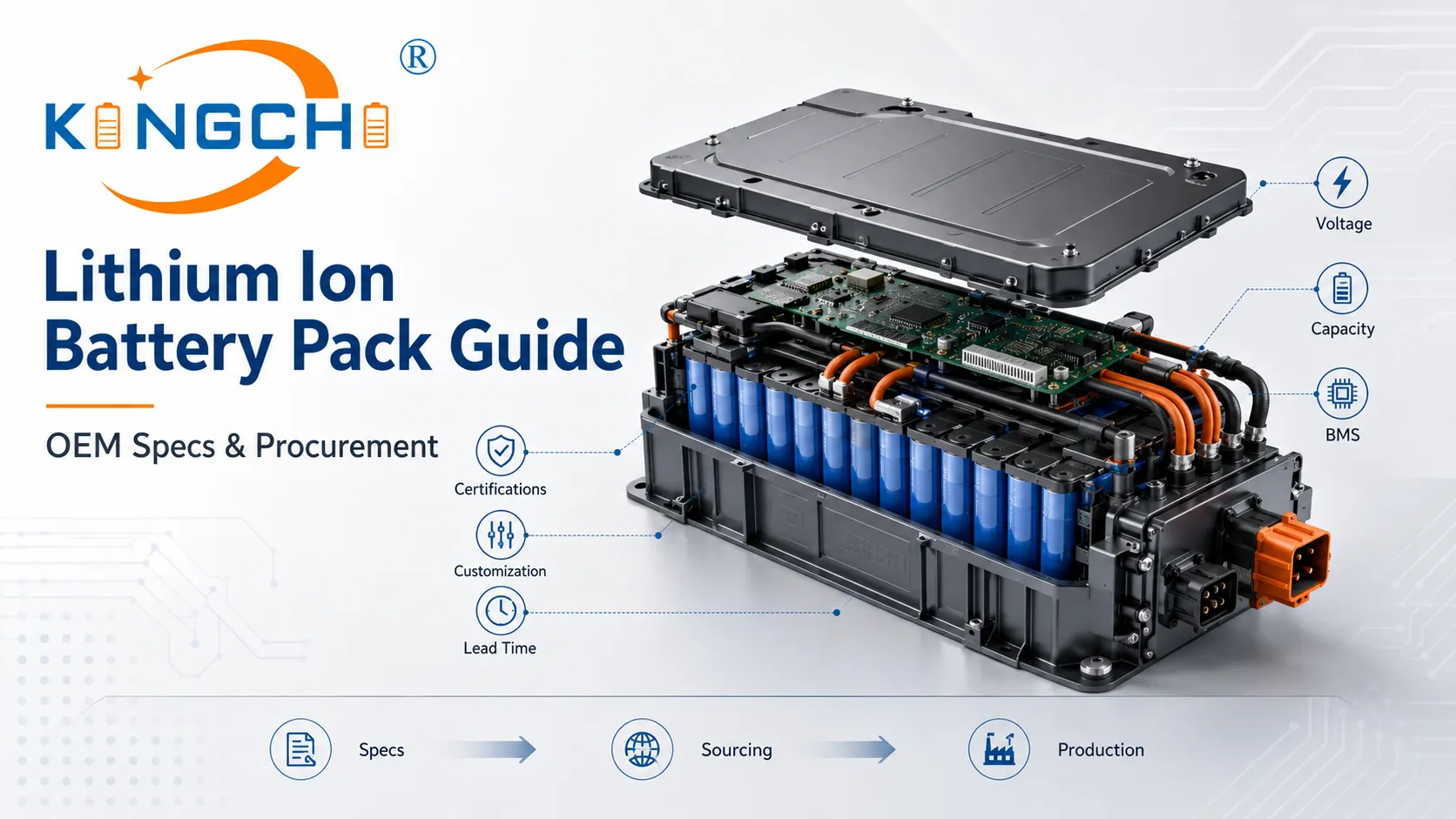
Most procurement failures start the same way: a specification sheet that treats a lithium ion battery pack as a simple voltage-and-capacity commodity. That assumption collapses the moment the application hits an unplanned thermal load, a vibration spike, or a customs inspector who demands test reports the supplier never generated. The real differentiator is not the cell count on a datasheet — it’s the engineered combination of cell selection, mechanical packaging, and protection logic that determines whether the pack survives a five-year field life or becomes a warranty headache after 400 cycles.
We see it in our work with OEM design teams and facility operators every day: the battery pack that looked identical on paper but delivered half the usable cycles because the BMS balancing strategy was mismatched to the duty cycle. This guide is built to help you navigate those hidden decision points, from chemistry trade-offs and compliance verification through to the procurement checklist that separates reliable industrial assets from expensive field liabilities.
Key Architectures of an Industrial Lithium Ion Battery Pack
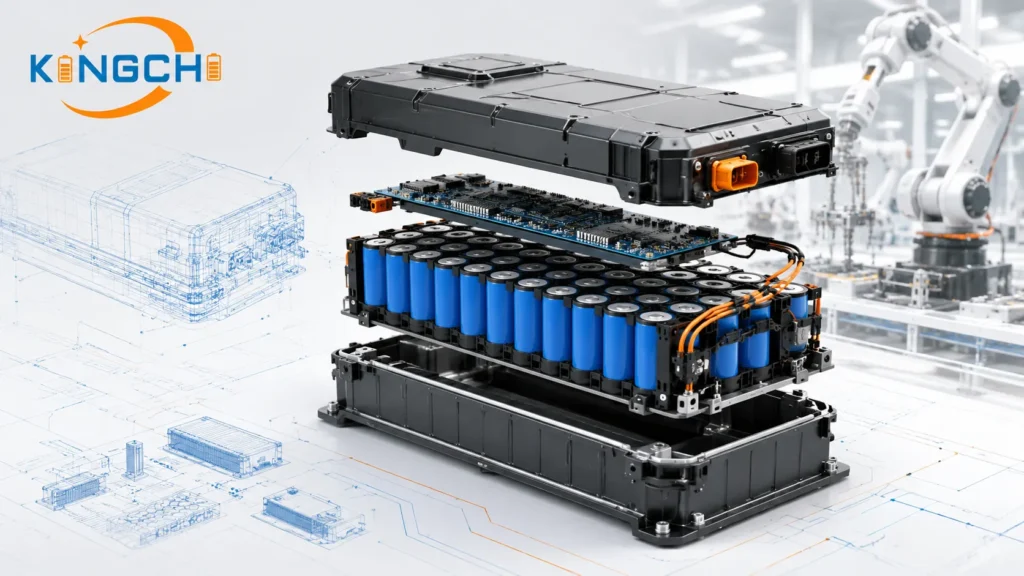
A commercial lithium ion battery pack is a highly engineered system consisting of individual electrochemical cells, a sophisticated Battery Management System (BMS), and physical protection tailored to nominal voltage and discharge requirements — it is never just a group of cells shrink‑wrapped together.
Cylindrical, Prismatic, and Pouch Cell Form Factors
The first architectural decision is cell geometry. Standard 18650 cells and their 21700 descendants offer high mechanical stability and excellent manufacturability, making them the default for many industrial packs. Their steel can enclosures provide inherent crush resistance, but the cylindrical shape leaves interstitial gaps that thermal management must address. Prismatic cells in aluminum housings use volume more efficiently and can be packed tightly, yet they require careful compression fixturing to prevent delamination-driven degradation over thousands of cycles. Pouch cells, often seen in ultra-thin consumer electronics and some UAV applications, deliver the highest gravimetric energy density but demand external mechanical restraint and are more susceptible to puncture; we typically recommend them only when the enclosure itself provides rigid planar support and the application tolerates a shorter service interval.
Each form factor brings a distinct failure mode profile, and the right choice hinges less on capacity per cell and more on how the thermal and mechanical environment cycles — a lesson many design teams only learn during the second prototype iteration.
The Role of the Battery Management System (BMS)
The Battery Management System (BMS) is the intelligence layer that turns a collection of cells into a safe, predictable power source. It continuously monitors:
- Individual cell voltages and pack-level nominal voltage
- Charging and discharging currents with Coulomb counting for state-of-charge (SoC) estimation
- Temperature at multiple sense points to detect thermal gradients
- State-of-health (SoH) trends by tracking internal resistance drift over time
Beyond monitoring, the BMS enforces safety boundaries. If a cell group drifts outside its safe voltage window, the BMS must disconnect the load or charger before irreversible lithium plating or oxygen release begins — the precursors to thermal runaway. In industrial systems, we look for a BMS that can communicate system status via CAN or SMBus, enabling the host equipment to make operational decisions based on real-time pack health rather than simply tripping an alarm. A basic hardware-only protection circuit may pass a bench test, but it will never tell a SCADA system that the pack is degrading faster than expected in a high-temperature enclosure.
What to verify: Confirm whether the supplier’s BMS is a smart digital platform with field‑adjustable parameters and remote communication interfaces, or a fixed‑threshold hardware protection board. We’ve seen procurement teams surprised by field‑replaceable unit costs because a low‑cost BMS could not be recalibrated when cells aged differently than the simulation predicted.
Designing Series and Parallel Configurations (S and P)
Voltage and capacity scaling is achieved through series and parallel (S/P) configuration. Series connections add cell voltages — a 4S string of 3.6 V nominal cells delivers 14.4 V. Parallel groups add amp‑hours, so a 3P group of 3 Ah cells yields 9 Ah of capacity. A 3S2P pack, therefore, combines three series stages with two cells in parallel per stage, delivering triple the single‑cell voltage and double the capacity.
The real engineering challenge is matching. Every cell in a parallel group must share current uniformly, which demands tight capacity, internal resistance, and self‑discharge matching. We enforce cell‑level grading tolerances far tighter than what a casual supplier might consider “acceptable,” because mismatched groups force the BMS to bleed energy continuously and erode cycle life. For larger packs, we avoid extremely high‑parallel‑count strings unless the mechanical design guarantees equal thermal exposure; thermal imbalance creates a feedback loop where hotter cells carry more current, become even hotter, and degrade faster.
Chemistry Selection: NMC vs. LFP in B2B Applications
Choosing between Lithium Nickel Manganese Cobalt Oxide (NMC) and Lithium Iron Phosphate (LFP) requires balancing energy density requirements against the desired lifecycle cost and safety margins of the application. There is no universally superior chemistry, despite what some datasheets imply.
Decision rule: If the application demands maximum runtime in a tightly space‑constrained form factor and thermal safety can be actively managed, NMC wins on energy density. If lifecycle cost, high‑temperature resilience, and intrinsic thermal stability are the dominant priorities, LFP is the safer engineering choice.
NMC (Nickel Manganese Cobalt) for High Energy Density
NMC chemistry still leads in volumetric and gravimetric energy density among mainstream lithium‑ion chemistries, often reaching 200–250 Wh/kg at the cell level. This makes it the go‑to for portable medical devices, high‑performance drones, and robotics where every gram matters. The trade‑off is a lower thermal runaway onset temperature — typically in the region of 150–200 °C for common NMC formulations — which demands a robust BMS and careful passive or active cooling. NMC also exhibits a moderate cycle life of 500–1,000 full-depth cycles under standard conditions, though this can be extended by limiting the operating state-of-charge window.
We often see OEMs gravitate toward NMC for first‑generation products that need to impress with runtime numbers, only to revisit the chemistry choice later when field returns show accelerated capacity fade in poorly ventilated enclosures. It’s a high‑performance material that punishes thermal neglect.
LFP (Lithium Iron Phosphate) for Long Cycle Life and Safety
LFP sacrifices roughly 20–30 % of the energy density NMC delivers, but it compensates with a cycle life that routinely exceeds 3,000 deep‑discharge cycles and a thermal runaway threshold that sits 100–150 °C higher. Its stable olivine structure resists oxygen release even under severe abuse, which fundamentally changes the safety architecture of the whole system. In stationary energy storage, heavy‑duty AGV battery packs for automated guided vehicles, and marine applications where sustained high‑rate discharge is common, LFP’s flat voltage curve and thermal resilience reduce the burden on the BMS and lower the total cost of ownership over a decade of operation.
The lower nominal cell voltage (3.2 V vs. 3.6–3.7 V for NMC) means more cells in series to reach the same pack voltage, so the mechanical packaging must absorb a slightly larger footprint. For many industrial users, that trade‑off is well worth the elimination of active liquid cooling loops.
To make the comparison actionable, here is a concise technical contrast:
| Parameter | NMC | LFP |
|---|---|---|
| Typical Cell Energy Density | 200–250 Wh/kg | 90–160 Wh/kg |
| Nominal Cell Voltage | 3.6–3.7 V | 3.2–3.3 V |
| Cycle Life (100 % DoD) | 500–1,000 cycles | 2,000–3,500+ cycles |
| Thermal Runaway Onset | ~150–200 °C (cathode dependent) | ~250–300 °C |
| Primary Industrial Use Cases | Medical devices, robotics, portable tools | Stationary storage, AGVs, marine, off‑grid |
Note: Specific energy and cycle life values depend on cell design, discharge rate, and operating temperature. Always verify supplier test data against your application’s load profile.
Custom vs. Standard Lithium Ion Battery Packs
While standard off‑the‑shelf lithium battery packs reduce development cost and time‑to‑market, custom lithium ion battery packs are required when application geometry, unique thermal loads, or highly specific load profiles dictate customized mechanical and electrical integration.
When Standard Configurations are Best
Standard packs work well when the available mechanical envelope matches a known industry form factor — think 24 V or 48 V rack‑mount modules for telecom, or 12 V drop‑in replacements for UPS systems. They offer lower upfront non‑recurring engineering (NRE) costs, pre‑certified compliance pathways, and immediate sample availability. For a facilities manager replacing lead‑acid cabinet batteries, a standard LFP pack with an integrated BMS is often the fastest path to deployment. The risk is forcing an application into a standard pack that was never designed for the real vibration spectrum or temperature swing, which may quietly degrade cycle life while staying within its warranty voltage limits.
Engineering Criteria for Custom Pack Designs
Custom designs become necessary when any of these conditions exist:
- The space claim is irregular and cannot be modified to accept a standard rectangular block.
- Vibration and shock loads exceed what off‑the‑shelf weld tabs and connectors can survive.
- Peak current demands require custom cell grading and multi‑layer busbar geometries that standard packs do not offer.
- Communication protocols must be deeply integrated — for example, a custom CAN bus profile that passes SoH data to a vehicle control unit.
In these cases, the NRE investment buys a lithium ion battery pack whose cell layout, thermal path, and connector positioning are co‑designed with the host product. The procurement trade‑off is longer lead time and a more involved qualification process, but the life‑cycle reliability typically outweighs the upfront cost when the alternative is repeated field failures in a hard‑to‑access location.
Critical Safety Standards and Compliance Requirements
Any lithium ion battery pack transported globally must undergo rigorous UN 38.3 certification testing to verify its safety under extreme altitude, vibration, impact, and thermal conditions. Without this report, freight carriers will reject shipments — and the liability for an uncertified pack is enormous.
Buyer warning: A UN 38.3 test report for the cell alone is not sufficient. The completed pack assembly, including its BMS and enclosure, must pass the full test sequence as a single unit. We advise procurement teams to request the test report number and verify it directly with the accredited lab.
UN 38.3 Transport Testing Demystified
The UN Manual of Tests and Criteria, Section 38.3, subjects the pack to eight tests: altitude simulation, thermal cycling, vibration, shock, external short circuit, impact/crush, overcharge, and forced discharge. A pass means the pack survived without mass loss, leakage, venting, disassembly, rupture, or fire. For OEMs shipping by air, additional restrictions under IATA dangerous goods regulations require state‑of‑charge limits (typically ≤30 %) for air transport. We see many first‑time exporters tripped up by this, confident that their pack is UN 38.3 compliant but unaware that UN38.3 certification is only one piece of the shipping puzzle.
UL Standards and Global Certifications
In addition to transport testing, end‑equipment integrators should verify that the pack has been tested to UL 1642 (cell safety) and UL 2054 (pack safety) if it will be installed in the North American market. For medical and industrial equipment, IEC 62133‑2 harmonizes safety requirements internationally. These are not automatically bundled; a supplier may offer a pack that is UN 38.3‑tested but not UL‑listed. We recommend that procurement explicitly ask, “Is the pack currently UL 2054 listed, or is a separate listing project required?” because the timeline and cost difference can be months and tens of thousands of dollars.
Navigating New International Environmental Rules
Regulatory trends are shifting from safety alone toward lifecycle accountability. EU Regulation 2023/1542 introduces a battery passport concept, requiring traceability of raw materials, carbon footprint declarations, and recycled content thresholds. While full compliance deadlines are phased, OEMs exporting into Europe should start asking suppliers about supply‑chain visibility and whether the pack can eventually support a digital product passport. Those who wait until the regulation is fully enforced risk being locked out of tenders that require this documentation from day one.
Thermal Management and Mechanical Packaging Design
Effective thermal management is the cornerstone of battery pack safety, preventing localized cell degradation from turning into catastrophic thermal runaway. If the thermal design can’t keep every cell within a 15–45 °C window during worst‑case operation, the warranty assumptions are already invalid.
Thermal Runaway Mitigation Strategies
Mitigation starts at the cell level with internal safety devices — positive temperature coefficient (PTC) current limiters and current interrupt devices (CID) — but the pack‑level design is what stops a single‑cell failure from cascading. We deploy a layered approach:
- Passive measures: thermal interface materials (gap fillers), aluminum heat spreaders, and phase‑change materials that absorb latent heat during a thermal spike.
- Active measures: forced‑air cooling for moderate discharge rates (up to ≈3C continuous) and liquid cooling plates for high‑discharge or fast‑charge systems where heat flux exceeds what air can carry.
- Propagation barriers: mica sheets or ceramic fiber separators between cell groups to slow thermal transfer even if one cell goes into runaway.
For high discharge rate lithium batteries used in power tools or heavy‑lift drones, the thermal management system must be capable of shedding several hundred watts of heat in seconds, which usually demands active cooling and aggressive BMS throttling thresholds.
Enclosure Materials and Ingress Protection (IP) Ratings
The enclosure is not just a box; it’s a pressure vessel, heat sink, and environmental barrier. We typically specify:
- Aluminum enclosures when thermal conductivity and EMI shielding are priorities. Extruded profiles with integrated fins can eliminate the need for a separate heat sink.
- Engineering‑grade plastics (PC‑ABS, glass‑filled nylon) for weight‑sensitive handheld devices, though we then add metallic inserts for heat spreading and ensure the design passes drop‑test sequences.
Engineering takeaway: An IP65 rating protects against dust and low‑pressure water jets, suitable for most outdoor stationary installations. IP67, which adds temporary immersion protection, becomes mandatory for marine drones, agricultural robots, or washdown environments where the pack may be submerged. We always verify the IP rating test was performed on a production‑representative assembly with its connectors mated, not an empty shell.
Lifespan, Degradation Factors, and Total Cost of Ownership (TCO)
Evaluating a battery pack solely on its upfront purchase price misses the true cost of operation, which is determined by cycle life, depth of discharge (DoD), and operating temperature profiles over years of field use. A pack that costs 30 % less at purchase but requires replacement twice as often can triple the per‑year cost with hidden downtime.
Environmental Factors That Accelerate Capacity Loss
Three operational conditions dominate degradation: high ambient temperature, sustained high C‑rates, and long storage at 100 % state‑of‑charge. At 45 °C, NMC cells can lose 20 % of their capacity in half the cycles they would achieve at 25 °C. This is largely driven by solid‑electrolyte‑interface (SEI) layer thickening, which consumes active lithium. We see the same acceleration when packs are fast‑charged to 100 % and then left plugged in overnight — a common scenario in material handling equipment that is often overlooked in procurement calculations.
We advise OEMs to specify the BMS to cap end‑of‑charge voltage at 4.1 V per cell (instead of 4.2 V) for NMC packs that must survive five‑year depreciation cycles. The slight reduction in initial runtime is repaid many times over in retained capacity at the 2,000‑cycle mark.
Calculating the Long-Term Cost of Energy Delivery
A simple TCO model divides total pack cost plus any ancillary cooling equipment by the total expected energy throughput (kWh cycled) over the design life. For example:
| Cost Element | Standard NMC Pack | Premium LFP Pack |
|---|---|---|
| Initial purchase cost (1.5 kWh pack) | $450 | $600 |
| Usable cycles at 80 % DoD | 800 | 2,500 |
| Lifetime energy throughput | 960 kWh | 3,000 kWh |
| Cost per kWh delivered | $0.47 | $0.20 |
Values are illustrative; actual costs depend on supplier pricing and application-specific fade characteristics. Buyers should request cycle‑life curves specific to their DoD and temperature profile.
A premium pack with a high‑quality BMS and conservative cell matching often delivers a cycle life cost that is less than half that of a cheaper alternative, purely because it avoids field replacements that generate downtime, technician visits, and disposal fees.
OEM Procurement and Specification Framework
Before finalizing a battery supplier, OEMs must perform due diligence on cell tier ranking, safety margins, and trace back technical specs against certified test reports. Relying on a supplier’s marketing datasheet alone is the fastest way to buy a pack that meets numbers on paper but fails in the application.
What to verify: Confirm the supplier’s cell tier classification. Tier‑1 cells from major manufacturers provide documented capacity matching, traceable lot‑level test data, and long‑term supply stability. Unbranded or “Grade B” cells may save cost initially but exhibit wider capacity distribution that the BMS must work harder to balance, and they may be unavailable for repeat orders.
Critical Parameters to Verify on Supplier Datasheets
When reviewing a supplier’s technical specification, these are the parameters that directly impact system integration and lifecycle performance:
- Continuous discharge current at the maximum ambient temperature, not just at 25 °C — verify the current does not cause cell temperatures to exceed the BMS cutoff.
- Peak pulse current duration and recovery time, because a 10‑second peak capability that requires a 30‑second rest may not suit a motor startup sequence.
- Charge temperature limits: most lithium‑ion packs cannot be safely charged below 0 °C without lithium plating; check if the BMS disables charging or if the pack includes a heater.
- Cell matching tolerance: ask for the allowable capacity and internal resistance spread — we target <1.5 % capacity deviation and <10 % IR variation for packs expecting more than 1,000 cycles.
- Communication protocol pinout: for smart BMS interfaces, verify CAN baud rate, Modbus register map, or SMBus command set so your firmware team isn’t reverse‑engineering after delivery.
Supplier Sourcing and Verification Checklist
We recommend OEM procurement teams request and verify the following before issuing a purchase order:
- A copy of the UN 38.3 test report, including the accredited lab’s name and report number — cross‑check the number with the lab.
- UL 1642 / UL 2054 listing certificates or proof of IEC 62133‑2 compliance, depending on target market.
- Material Safety Data Sheet (MSDS) and cell manufacturer’s production specification with traceable lot numbers.
- A sample of five packs for in‑house qualification, not one, so you can measure cell‑to‑cell voltage deviation after a full charge‑discharge cycle.
- Evidence of the supplier’s serial‑number traceability system and their recall procedure — if a cell lot is recalled, can they trace every shipped pack?
We’ve seen too many projects stall at the prototype stage because the supplier’s “certified” pack turned out to have passed testing only for a physically different enclosure or BMS revision. For more guidance on selecting a reputable source, our battery sourcing guide walks through the full evaluation sequence.
Partnering with a Qualified Battery Engineering Specialist
Choosing the correct lithium ion battery pack requires balancing complex physical, electrical, and regulatory variables that are best navigated alongside an experienced power integration partner. The earliest conversations should focus not on price but on whether the supplier asks the right questions about your load profile, thermal environment, and regulatory pathway.
Before engaging battery pack solutions providers, gather these specifications from your engineering and product teams:
- Available envelope dimensions with any mounting constraints and keep‑out zones for connectors.
- Nominal and peak voltage targets, including any voltage sag tolerance the downstream electronics can accept.
- Continuous and peak discharge current profiles — preferably a time‑based current trace rather than a single number.
- Required runtime under a defined duty cycle, because “8‑hour runtime” means little without knowing the load profile.
- Environmental IP rating requirement (IP65, IP67) and the maximum and minimum operating temperatures.
With those parameters in hand, our engineering team can quickly narrow down whether a standard pack matches the need or whether a custom design with integrated battery management system logic is the faster route to a reliable field deployment. We invite you to discuss your integration layout or evaluate standard pack options directly with us so that the battery becomes a source of competitive advantage, not a late‑stage project risk.
Frequently Asked Questions
What is the difference between a lithium‑ion battery cell and a battery pack?
A cell is the individual electrochemical unit — such as an 18650 cylindrical cell — while a battery pack contains multiple cells electrically connected in series and parallel, integrated with a protective BMS, and packaged inside a mechanical enclosure that provides environmental protection and connector interfaces.
Why is a BMS required for lithium ion battery packs?
Lithium‑ion chemistries operate safely only within tight voltage and temperature windows; a BMS actively prevents dangerous overcharging, over‑discharging, and cell imbalances that would otherwise lead to thermal runaway or permanent capacity loss.
Can I ship a lithium ion battery pack on commercial aircraft?
Large‑format industrial lithium ion battery packs are classified as dangerous goods and cannot be shipped on passenger aircraft. They must be transported via cargo‑only pathways under strict adherence to UN 38.3 shipping standards and relevant IATA/ICAO regulations.
How does temperature affect the performance of a lithium ion battery pack?
Cold temperatures increase internal resistance, which reduces usable capacity and voltage under load, while sustained high temperatures accelerate chemical degradation and SEI growth — both extremes demand careful thermal management to maintain cycle life and safety.
What are the primary signs of a failing or degraded lithium‑ion pack?
Watch for visible swelling or bloating of the enclosure, a rapid drop in runtime during normal discharge cycles, failure to hold a charge after being disconnected, or unusual heat buildup during operation that was not present when the unit was new.
Frequently Asked Questions

Get a Fast, Custom Power Quote


 English
  Turkish
  Arabic