Guide to High Discharge Rate LiPo Battery Selection & Sourcing
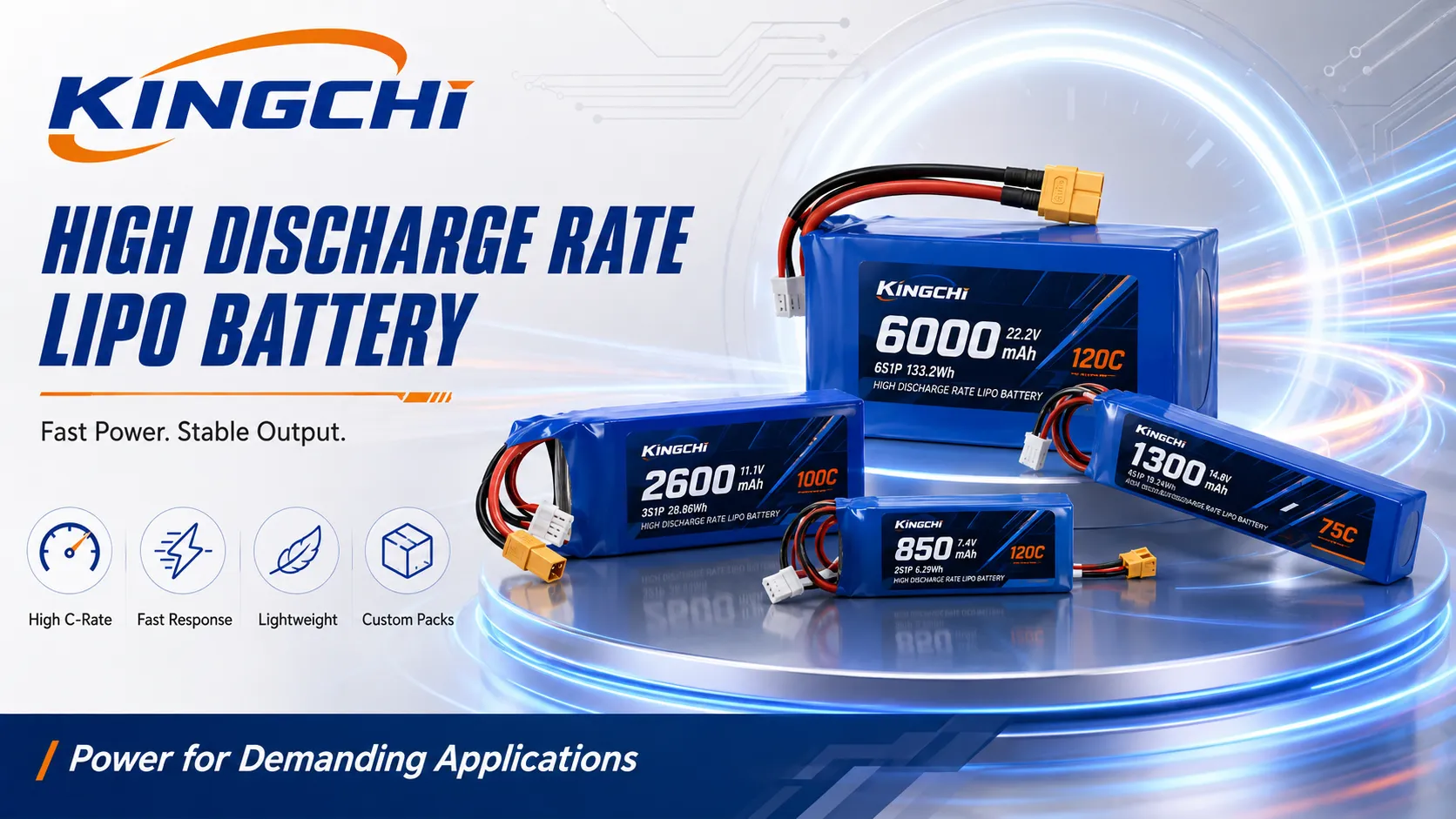
We regularly see engineers over-specify a battery based on a vendor’s advertised C-ratings, only to discover during load testing that the cell’s voltage sags below a usable threshold—because the supplier’s numbers were inflated or based on a 1-second burst. Selecting a genuine high discharge rate lipo battery isn’t about chasing the highest number on a spec sheet; it’s about understanding cell construction, internal resistance, and real-world degradation curves.
In this engineering guide, we cut through the marketing noise to explain the chemistry, manufacturing methods, and procurement checks you need to source cells that deliver consistent high current—without compromising safety or cycle life.
What Is a High Discharge Rate LiPo Battery? Definitions and C-Rating Mechanics
A high discharge rate lipo battery is a lithium-ion polymer cell specifically engineered to deliver continuous currents exceeding 50C (and pulse bursts up to 150C) without experiencing severe voltage sag or destructive thermal escalation.
The Electrochemical Definition of High Discharge Capability
At the electrochemistry level, high-rate capability stems from reducing the ionic transport bottleneck inside the cell. Manufacturers modify the active electrode coatings—using finer particle sizes and higher porosity—so lithium ions can move more freely between anode and cathode. The electrolyte is also formulated with higher ionic conductivity to support rapid ion exchange. The result is a cell that can sustain massive current draws without starving the electrodes, which would otherwise cause immediate voltage collapse. In contrast, standard cells prioritize energy density over rate performance, often using denser electrode materials that limit the speed of intercalation and de-intercalation under heavy load.
Deciphering the C-Rating: Continuous vs. Burst Current
The C-rating defines the maximum safe discharge current relative to capacity. The fundamental equation is:
Continuous Current (A) = Capacity (Ah) × C-Rating
For a 2000 mAh (2 Ah) cell rated for 50C continuous, that means 2 Ah × 50 = 100 A sustained. Burst ratings, often quoted as “120C pulse,” may apply for only 1–3 seconds and should never be treated as a safe steady-state value. Buyer warning: consumer-grade brands frequently inflate C-ratings by reporting burst values as if they were continuous.
When sourcing cells for industrial equipment, we recommend verifying the continuous C-rating through high discharge rate lithium batteries test reports rather than relying on marketing labels. A genuine 50C continuous cell will often exhibit a tested internal resistance below 2 mΩ. If the supplier cannot produce a discharge curve at the claimed rate, assume the rating is overstated.
Stacking vs. Winding: The Manufacturing Processes Dictating Battery Performance
B2B buyers should specify stacked-electrode lithium polymer cells for high-rate applications because stacking offers dramatically lower internal resistance and superior thermal dissipation compared to traditional wound designs. The fabrication method directly determines how current flows, how heat spreads, and whether the cell can truly sustain repeated high-rate cycles without early degradation.
The Stacking Method: Lowering Internal Resistance (IR)
In a stacked pouch cell, individual anode and cathode plates are cut and layered in parallel, with separators in between. This avoids the physical tension and curved edges inherent in wound configurations. Current distributes uniformly across the entire electrode area, rather than funneling through a single long foil. The result is a cell with internal resistance (IR) values often below 1.5 mΩ per cell, minimal voltage depression, and excellent heat dissipation. Stacking also reduces mechanical stress that can cause electrode delamination over hundreds of cycles, a critical factor for high discharge lithium packs used in UAVs and robotics.
The Winding Method: Cost-Efficiency and High-Rate Limitations
Wound cells—whether cylindrical or wound prismatic—roll the electrode and separator into a compact jellyroll. The process is faster and cheaper, but it introduces high internal resistance at the tight inner turns and hot spots at the curvature. Under high current, the voltage drop across the winding length becomes significant, and uneven thermal expansion can cause physical swelling and capacity loss. Wound cells typically max out at 10C continuous; pushing them higher leads to rapid heating and cycle life collapse.
Engineering takeaway: for applications requiring sustained currents above 20C, accept nothing less than a verified stacked-electrode design. Use the following table to quickly compare the two methods.
| Parameter | Stacked Pouch Cells | Wound Cylindrical/Prismatic Cells |
|---|---|---|
| Continuous C-Rate Capability | 50C–120C | 1C–20C typical |
| Internal Resistance | Low (<2 mΩ per cell) | Higher (>5 mΩ) |
| Voltage Sag under Load | Minimal, flat plateau | Significant drop |
| Thermal Dissipation | Excellent (uniform current density) | Hot spots at curvature |
| Volumetric Energy Density | 180–220 Wh/kg | 200–250 Wh/kg |
Data based on typical high-rate LiPo pouch cell specifications; verified performance should be confirmed via manufacturer test reports.
Performance Comparison: High Discharge Rate LiPo Battery vs. Standard LiPo
Under identical high-amperage loads, a high discharge rate lipo battery maintains a higher, flatter voltage platform throughout its cycle, whereas a standard cell suffers rapid voltage depression and critical thermal spikes. This performance gap widens as the load approaches the cell’s limit, making component selection a decisive factor for mission-critical systems.
Analyzing the 40C Discharge Curve and Voltage Platforms
When we discharge a standard LiPo at 40C (well beyond its design range), its voltage collapses within seconds from the nominal 3.7 V per cell to below 3.0 V, causing immediate system brownouts. A genuine high-rate cell designed for 50C continuous will hold around 3.55 V for the first 80% of capacity before gradually entering the knee of the curve. This flat voltage platform is essential for drones and power tools that demand consistent torque and thrust. The difference comes down to internal resistance (IR): high-rate cells convert less energy into heat, preserving the driving voltage even as current peaks.
Fast Charging Latency and Cycle Life Trade-offs
Because they are built with low IR, high-rate cells can accept charge currents up to 5C, reducing recharge time to under 25 minutes. Standard LiPos are typically limited to 1C, making them impractical for high-duty-cycle industrial applications. However, sustained high-rate discharging accelerates cycle life degradation through elevated internal temperatures. In our testing, a 30C-rated high-discharge pack retained about 93% capacity after 300 cycles, while a 40C-rated version dropped to roughly 85% under the same thermal management. Buyer warning: you must factor in thermal management and expected cycle counts when selecting a C-rating; overspeccing without cooling can still cut service life.
| Performance Metric | High Discharge Rate LiPo | Standard LiPo |
|---|---|---|
| Voltage at 40C Load | ~3.55 V (stable) | Drops below 3.0 V rapidly |
| Charge Rate | Up to 5C (15–25 min) | 1C typical (60–80 min) |
| Cycle Life at High Rate | ~300 cycles at 85% capacity retention | Degrades below 200 cycles |
| Thermal Build-up | Moderate (requires cooling) | Excessive (risk of shutdown) |
Measurements based on controlled lab conditions using stacked-electrode cells; field results depend on pack design and ambient cooling.
Commercial and Industrial Applications Demanding High-Rate Output
High-rate lithium polymer cells are critical for systems requiring instant, massive power spikes—such as emergency starting units—or continuous high-torque operations, such as industrial agricultural drones and heavy-duty robotics. These applications leave no room for voltage sag that could cause control-system resets or loss of lift.
Commercial UAVs, Heavy-Duty Robotics, and Agricultural Drones
Agricultural spray drones exemplify the need for UAV batteries with high discharge rates. They face rapid throttle changes, heavy payload variations, and high ambient temperatures. In these environments, a standard LiPo would overheat within minutes. High-rate stacked pouch cells deliver the sustained current to lift 20+ kg payloads while keeping cell temperatures below 60°C. Similarly, autonomous mobile robots and AGV batteries with high discharge rates demand repetitive high-current acceleration bursts—exactly the use case where low IR prevents premature failure.
Best-fit scenario: any unmanned system with a takeoff weight exceeding 10 kg or requiring a thrust-to-weight ratio above 2:1 should be powered by stacked-electrode high-rate LiPo cells.
Emergency Medical Devices and Automotive Jump Starters
Portable defibrillators and emergency ventilators rely on pulse discharge capability: they must deliver a single massive jolt of current instantly, even after months of standby. In automotive jump starters, a compact pack must output hundreds of amps for several seconds while maintaining a voltage high enough to crank an engine. Standard LiPos would collapse under such a load. High-rate cells designed with ultra-low IR can provide these pulse currents reliably, but the procurement team must validate that the cell’s burst rating aligns with the pulse duration required by the device.
Professional Cordless Power Tools and Peak-Load Shaving Modules
Industrial-grade power tools—especially rotary hammers and high-torque impact wrenches—create intermittent high-current draws that would cause standard batteries to trip BMS protections. By using high-discharge cells, manufacturers can build smaller, lighter packs that still deliver the necessary peak power. In grid-support systems, high-rate LiPo modules are also deployed for peak-load shaving, absorbing and releasing energy in sub-second bursts to stabilize voltage fluctuations.
Safety Risks, Thermal Dissipation, and Failure Modes
Drawing excessive current from a cell with an insufficient C-rating triggers rapid heat accumulation, electrode decomposition, and lithium plating, which can lead to swelling, internal short-circuits, and eventual thermal runaway. Engineering teams must treat thermal management as a core design requirement, not an afterthought.
Thermal Runaway Triggers under High Current Load
When a cell’s continuous discharge rate is exceeded, internal ohmic heating raises the core temperature above 80°C. The electrolyte begins to decompose, generating flammable gases. At this point, the separator can melt, causing an internal short, and the cell enters an uncontrolled exothermic reaction. This process can initiate in under 10 seconds. Mitigation demands:
- Selecting cells with a continuous C-rating at least 20% above the maximum expected load.
- Integrating a BMS for high discharge batteries that monitors per-cell temperature and disconnects before thermal thresholds are breached.
- Using prismatic pouch cells with direct cooling plate contact, as their flat geometry dissipates heat more effectively than cylindrical formats.
Physical Swelling and Electrode Lithium Plating
Swelling is a visible warning sign of severe internal degradation. Under high-rate discharge, if the anode potential drops too low, lithium ions plate as metallic lithium on the electrode instead of intercalating. This not only reduces capacity but also creates sharp dendrites that can pierce the separator. The cell bulges as gas from electrolyte decomposition accumulates. Risk if ignored: a swollen cell is a fire risk and should be replaced immediately. During prototype validation, we recommend logging cell thickness after every 50 high-rate cycles and discarding any pack showing more than 5% thickness increase.

Regulatory Compliance and Safety Certifications for OEM Procurement
Commercial developers must verify that their chosen battery supplier holds current, third-party testing certifications—such as UN38.3 and IEC 62133-2017—to ensure transit safety compliance and end-product liability protection. Do not accept self-declaration; demand complete lab reports with serial numbers.
IEC 62133-2017: Safety Standards for Portable Applications
IEC 62133-2017 sets the safety requirements for portable sealed secondary lithium cells and batteries used in industrial and medical equipment. It covers critical abuse tests: overcharge, forced discharge, short circuit, crush, and thermal abuse. Passing this standard demonstrates that the cell design is robust enough for B2B integration. Procurement teams should request the certification certificate along with the corresponding test report that lists the exact cell model and manufacturing date.
UN38.3: Transit and Safe Transport Shipping Verification
Before any lithium battery can be shipped by air, sea, or ground, it must pass UN38.3. This suite of tests—including altitude simulation, thermal cycling, vibration, shock, and forced discharge—ensures the battery can withstand the rigors of transport without catastrophic failure. What to verify: the UN38.3 certification for high discharge batteries report must match the specific cell chemistry and form factor you are purchasing, not a generic family certification.
UL 1642: Standard for Safety of Lithium Batteries
UL 1642 focuses on lithium cell safety, covering electrical, mechanical, and environmental tests, including abnormal charging and forced discharge. While not always required for every region, having UL 1642 compliance provides additional third-party assurance and simplifies approval processes for products entering North American markets. Like other certifications, the report should be traceable to the specific cell lot.
Engineering Checklist: Specifying and Vetting a Custom Pouch Cell Supplier
When specifying custom high-discharge cells, engineering teams must evaluate the vendor’s actual testing capabilities, demanding continuous-discharge test data sheets and raw internal resistance values from factory production lots. Without this, you risk designing around a “golden sample” that does not represent bulk production.
Dimensional Constraints vs. Performance Metrics
Custom prismatic pouch cells can be manufactured in thicknesses from 3.5 mm to roughly 11.2 mm, allowing tight integration into handheld or compact UAV designs. However, thinner cells mean less active material and thus lower capacity. Every millimeter of thickness added can increase capacity and improve heat capacity, but may push the mechanical envelope. When working with a supplier, provide:
- Target nominal capacity (mAh) and voltage per cell.
- Continuous and peak current draws (e.g., 80C continuous, 120C burst for 2 seconds).
- Physical dimensions (length × width × thickness, including tolerance stack-ups).
- Required cycle life at the target discharge rate.
- Desired connector type and cell layout (single, series, parallel arrays).
Decision rule: specify a continuous C-rating at least 20% above your peak calculated load to avoid operating at the cell’s absolute limit, where degradation accelerates. This also gives headroom for thermal management.
Quality Control: Vetting the Golden Sample vs. Production Lots
A common procurement mistake is to validate only the supplier’s pre-production samples. We recommend implementing a lot acceptance test that measures the internal resistance (IR) of a random sample using an AC micro-ohmmeter. If IR varies by more than ±10% from the agreed specification, the lot should be quarantined. Continuous discharge test data from the factory should be provided for each batch. This level of scrutiny is standard for industrial drone manufacturers and prevents field failures from inconsistent cell quality.
When comparing suppliers, ensure they can provide custom high discharge battery packs with documented manufacturing process controls, not just assembled from commodity cells. The ability to trace a cell’s IR and capacity back to its manufacturing date and line is a mark of a reliable OEM partner.
Design Your High-Power Power System with Our Application Engineers
Selecting the ideal cell requires balancing complex thermal, mechanical, and electrical parameters; collaborating with experienced battery engineers early in the design cycle avoids costly layout revisions. Whether you need a bespoke 6S high-rate pack for a heavy-lift drone or a compact high-pulse module for a medical device, our team can guide the cell selection, pack architecture, and BMS tuning.
Before you contact us, prepare the key parameters: target capacity (mAh), voltage requirements (series/parallel configuration), peak and continuous current draws, physical dimensional limits, and any regulatory certifications your product must meet. This allows us to rapidly evaluate candidate cells from our high discharge rate LiPo battery products and provide performance curves specific to your load profile. For custom configurations, we also offer custom power solutions that include UL, UN38.3, and IEC 62133 compliance documentation.
Frequently Asked Questions
What constitutes a “high” discharge rate for a LiPo battery?
While standard consumer batteries operate around 1C to 5C, a high discharge rate lipo battery is defined by its ability to safely deliver continuous currents of 50C to 120C without exceeding thermal limits or suffering destructive voltage sag.
How do you calculate the maximum safe current of a high discharge rate lipo battery?
Use the formula Amps = (Capacity (mAh) × C-Rating) / 1000. A 5000 mAh pack with a 60C continuous rating can safely deliver up to 300 Amps. Always use the continuous rating, not the burst rating, for safe current calculations.
Can you fast charge a high-discharge LiPo battery?
Yes. Because they are designed with low internal resistance, many high-discharge LiPos can support fast charging at rates up to 5C, fully charging in under 20–25 minutes, though standard cells should generally be limited to 1C to prevent plating.
What is the main structural difference between standard and high discharge rate lipo batteries?
High-rate cells typically rely on advanced stacked-electrode construction rather than wound configurations, which, along with modified electrode chemistry, yields dramatically lower internal resistance and better heat dissipation.
Why does a high-discharge battery swell, and how can it be avoided?
Swelling occurs when internal temperatures exceed safe limits or when drawing currents beyond the cell’s true capabilities, causing electrolyte decomposition. It can be mitigated by ensuring proper cooling, staying within the continuous C-rating, and sourcing certified high discharge rate lipo battery cells.
Frequently Asked Questions

Get a Fast, Custom Power Quote


 English
  Turkish
  Arabic