High Discharge Lithium Batteries: B2B Sourcing Guide – Kingchi
Voltage sag under load isn’t just a performance issue—it can mean a failed prototype, a stalled production line, or a costly safety recall.
In heavy industrial designs, drawing hundreds of amperes from a battery pack requires specialized electrochemical engineering that standard consumer cells simply cannot survive.
To prevent field failures, OEM engineers and procurement managers must look beyond nominal capacity and examine the internal resistance, thermal dissipation, and electrode chemistry of high discharge rate lithium batteries.
Our engineering team at Kingchi has developed this technical guide to help you specify, analyze, and source these high-demand power systems with confidence.
What Defines High Discharge Rate Lithium Batteries?
Understanding C-Rate and Peak Current Performance
The discharge capability of any battery cell is mathematically defined by its C-rate, which represents the rate at which a cell is discharged relative to its maximum capacity. A 1C rate means the discharge current will fully deplete the cell in one hour; consequently, a 10C rate will deplete it in six minutes, and a 20C rate in three minutes. Managing the internal resistance of the battery is fundamental to achieving sustained peak current battery performance under maximum load conditions.
Why is internal resistance the ultimate bottleneck for high-rate applications?
The answer lies in Joule heating, which converts lost voltage directly into destructive thermal energy. When choosing cylindrical form factors for medium-duty power tools, selecting high-rate industrial 18650 cells ensures a balance of density and output. For newer designs requiring higher energy capacity along with raw current, upgrading to high discharge rate 21700 cells provides better volumetric efficiency.
- Thicker current collectors: Heavy copper and aluminum foils reduce physical resistance at the electrode-tab junction.
- Multi-tab designs: Utilizing multiple cathode and anode tabs reduces electron travel distance, minimizing local hotspots.
- High-conductivity electrolytes: Proprietary organic solvents optimized to facilitate rapid lithium-ion transport.
Heavy-lift drones operating under high wind loads demand specialized pack construction to maintain peak current battery performance for drones.
LiFePO4 vs. LiPo vs. NMC: Which Chemistry Delivers?
No single lithium chemistry fits every industrial application. Engineers must continuously navigate the trade-offs between energy density, cycle life, and safety when specifying high-rate battery packs.
| Chemistry Type | Nominal Voltage | Max Continuous C-Rate | Energy Density (Wh/kg) | Typical Cycle Life | Safety Profile |
|---|---|---|---|---|---|
| Lithium Iron Phosphate (LiFePO4) | 3.2V | 10C to 15C | 120 – 160 | 2,000 – 3,500 | Excellent (High Thermal Stability) |
| Lithium Polymer (LiPo Pouch) | 3.7V | 25C to 75C+ | 180 – 220 | 150 – 300 | Moderate (Prone to swelling) |
| Nickel Manganese Cobalt (NMC) | 3.6V – 3.7V | 15C to 30C | 200 – 250 | 300 – 500 | Good (Requires active BMS) |
Data sources: Kingchi electrochemical testing laboratory cyclic stress reports (2024), cell level performance specifications under constant temperature of 25°C.
Consider a practical engineering comparison: a 3.7V 18650 NMC cell rated at 30A continuous discharge versus a LiFePO4 cell rated at 45A. If your design prioritizes space and lightweight performance—such as a specialized UAV—the higher nominal voltage and energy density of the NMC chemistry will optimize the power-to-weight ratio.
Conversely, if you are designing a high-vibration power tool pack or material handling system where daily heavy cycling and physical safety are paramount, the LiFePO4 chemistry becomes the superior design path.
Key Performance Metrics for Industrial Applications
Continuous vs. Burst Discharge in High Discharge Rate Lithium Batteries
In high-rate industrial operations, understanding the distinction between continuous discharge and burst discharge is critical.
A continuous rating indicates the current level the cell can maintain indefinitely until depletion without exceeding safe thermal thresholds.
A burst rating—often limited to 5 to 10 seconds—defines the peak transient current the cell can handle during momentary high-torque demands.
Our engineering team commonly implements these custom cells in high-power systems like rapid discharge power tool packs to maximize runtimes under high startup loads. In contrast, sustained industrial flight profiles may opt for a balanced 5C continuous discharge battery pack to extend overall lifespan.
- Power tools: High-burst startup transients (up to 100A for 2 seconds) transitioning to a steady 15-20A working current.
- UAV propulsion: 3-to-1 ratio where steady-state hovering requires low C-rates, but rapid ascent requires intense bursts.
- Emergency jump starters: Extreme pulse-only requirements (1000A+ for 3 seconds) with virtually zero long-term continuous demand.
We also apply these same parameters to material handling equipment, tracking peak current battery performance in AGVs to ensure trouble-free warehouse cycles.
Voltage Sag and Its Impact on Equipment Efficiency
Voltage sag occurs when the internal resistance (IR) of the cell opposes the rapid flow of electrons, dropping the terminal voltage of the cell under load according to Ohm’s Law (V_sag = I × R_internal).
When voltage drops significantly, the efficiency of your system’s motor controllers and power converters degrades rapidly. This loss of voltage means your motor has to draw even more current to achieve the same wattage output, creating a destructive thermal loop.
| Cell Configuration (3.0Ah Pack) | Internal Resistance (IR) | Voltage Sag at 20A Load | Power Dissipated as Heat | Efficiency Impact |
|---|---|---|---|---|
| Standard Energy Cell | 38 mΩ | 0.76 V per cell | 15.2 Watts | Severe (Early cutoff triggered) |
| High-Rate Industrial Cell | 11 mΩ | 0.22 V per cell | 4.4 Watts | Minimal (Optimal motor performance) |
Data sources: Kingchi internal multi-channel battery analyzer tests at 23°C ambient temperature.
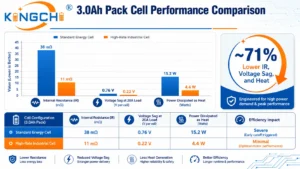
This performance difference demonstrates that high internal resistance wastes stored capacity and generates hazardous localized heat. Selecting cells with low, verified internal resistance is the only way to safeguard your product’s run-time and preserve the overall health of the pack.
Thermal Management in High-Rate Cells
Why Heat Is the #1 Enemy of High Discharge Rate Lithium Batteries
Effective thermal management in high-rate cells is not an afterthought; it is a fundamental safety parameter that determines product lifespan. As a pack discharges at high C-rates, the heat generated inside the cell core cannot escape quickly enough through the steel or aluminum casing.
This internal temperature buildup degrades the polymer separator, accelerates the breakdown of the electrolyte, and can lead to thermal runaway.We have analyzed the unique aerodynamics and cooling paths in our guide on thermal management in drone batteries.
- Thermally isolated cells: Keeping cylindrical cells isolated from direct contact with neighboring cells using UL94-V0 plastic frames.
- Thermal interface materials (TIM): Utilizing high-conductivity gap pads to transfer heat from the cell caps directly to the aluminum chassis.
- Redundant temperature sensing: Placing multiple NTC thermistors on the physical busbars and middle cells where heat naturally accumulates.
Using a dedicated, thermally protected battery charger for high-rate packs ensures the cells are recharged safely without thermal stress.
Design Strategies for Heat Dissipation
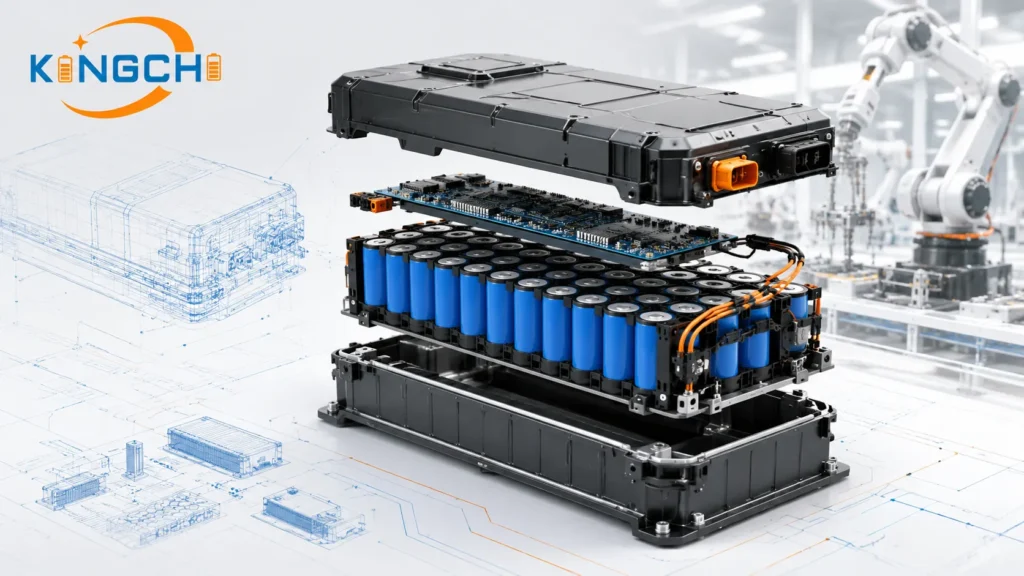
When we engineer custom battery enclosures for industrial and military OEMs, we employ three distinct thermal mitigation architectures.
First, we use thick aluminum heatsinks directly bonded to the nickel or copper busbars. Because metallic busbars act as direct heat pipes from the core of the cells, extracting heat from the cell terminals is incredibly efficient.
Second, in highly compacted designs such as rugged power tool modules, we inject specialized silicone-based potting compounds. This compound fills every air gap in the enclosure, providing structural rigidity and transferring heat outward to the enclosure walls. For heavy duty cycle applications, active cooling via forced air channels is integrated into the enclosure shape, allowing cold air to circulate around each cell.
How to Vet a High Discharge Battery Supplier: 5 Critical Questions
Procuring high-rate lithium systems requires rigorous technical qualification. Use this five-step checklist to evaluate prospective manufacturing partners before placing high-volume orders:
- Can you supply continuous discharge curves up to the cell’s maximum rated current at multiple temperatures? Reputable suppliers must provide verifiable data showing how their cells perform under sustained load at low (-20°C) and high (60°C) temperatures. Do not rely on nominal datasheet specs.
- What are your cell-to-cell internal resistance (IR) matching tolerances? For high-rate multi-cell packs, cell matching is critical. At Kingchi, we strictly enforce an IR tolerance of <1.5mΩ and a capacity variance of <1% across a production batch.
- What mechanical structural tests do your pack configurations undergo? High-rate systems are often deployed in high-vibration settings. Ensure your supplier tests assemblies to UN38.3 vibration standards and performs simulated drop and mechanical shock tests.
- Is your Battery Management System (BMS) rated for continuous thermal loading? A cell pack may handle 100A, but a poorly engineered BMS with high-resistance FETs will quickly overheat. Request the thermal imaging reports of the BMS board operating under full continuous load.
- How do you handle cell safety venting in sealed enclosures? High-rate cells under extreme abuse will vent gas. Ensure the pack enclosure includes a membrane vent or safety release valve to prevent explosive pressure buildup.
At Kingchi, our manufacturing facility handles the entire process. From modeling thermal expansion to customizing high-current BMS protection circuits, we work alongside industrial OEMs to transition prototypes into reliable mass production.
3 Pitfalls That Cost Engineers Time and Money
Engineering teams frequently make critical assumptions during the design cycle that result in premature field failures or assembly line delays:
- Mistake 1: Confusing peak current with continuous rating. Relying on a cell’s advertised “60A pulse” capability to run a continuous 45A application will cause the cells to overheat within seconds. Always design your continuous load profile to fall within the continuous C-rate spec of the chemistry.
- Mistake 2: Ignoring cycle life degradation at high rates. While a cell may be capable of a 30C discharge, running it at its limit will rapidly reduce its lifespan from 500 cycles down to less than 150. If you need a long product lifespan, you must over-specify the battery capacity to reduce the operating C-rate.
- Mistake 3: Overlooking the physical resistance of busbar connections. Even with premium low-IR cells, thin nickel strips with weak spot welds will introduce significant path resistance. This creates localized heating at the terminals, tricking the BMS thermal sensors into early shutdown.
What’s Next: High-Rate LFP, Solid-State, and Beyond
The next evolution of high-rate electrochemistry is focusing heavily on safety and raw power density. High-rate Lithium Iron Phosphate (LFP) cells are seeing significant advancements, with newer chemistries approaching 15C continuous discharge rates.
This progress allows heavy machinery and AGV manufacturers to replace heavier lead-acid or bulky NMC packs with long-lasting, safe LFP technology.In addition, solid-state electrolytes are moving closer to commercial reality. By replacing flammable liquid electrolytes with solid ceramics or polymers, next-generation cells will theoretically sustain ultra-high-rate discharges without the risk of thermal runaway.
At Kingchi, our engineering team continues to test and implement these emerging material technologies. We refine our high-current BMS and structural pack designs daily to ensure our OEM partners receive stable, high-performance battery packs that stand up to the most demanding industrial conditions.
Frequently Asked Questions
What is the highest continuous discharge rate available in a lithium battery?
In commercial pouch cells (LiPo), continuous rates of 75C to 120C are achievable for short bursts in defense or specialized aerospace systems. For rugged, high-volume industrial equipment and power tools using cylindrical formats, continuous ratings between 15C and 30C represent the practical limit for balancing thermal stability and cycle life.
Can I use a high-discharge battery for both power tools and energy storage?
It is not recommended. High-rate cells use thin electrode layers and specialized additives that prioritize power delivery over maximum capacity. For energy storage systems, energy density and low self-discharge are far more important, meaning general-purpose, high-capacity cells are a much more cost-effective choice.
How do I calculate the required C-rate for my application?
To calculate the minimum C-rate, divide your system’s maximum continuous current draw in Amperes by the total capacity of the battery pack in Ampere-hours. For example, a heavy duty motor drawing 60A continuous from a 5.0Ah battery pack requires a cell configuration rated for at least 12C continuous ($60A / 5.0Ah = 12C$).
Are high-discharge LiFePO4 batteries safe?
Yes, LiFePO4 is inherently one of the safest lithium chemistries available due to its robust structural and chemical stability. Even under high physical damage or direct short-circuit conditions, LFP resists thermal runaway far better than NMC. However, because high rates still generate resistive heating, robust thermal design and a high-quality BMS are still necessary.
What certifications should I look for in a high-rate battery supplier?
Ensure your supplier can provide UN38.3 certification for safe transport, along with cell-level certifications such as UL 1642 and IEC 62133. For customized pack assemblies, ask for finished product certifications such as CE, FCC, and RoHS compliance to streamline your own system-level approvals.
How does Kingchi ensure cell quality for high-rate applications?
We perform 100% cell sorting using high-precision automated sorting equipment to match cells on both capacity and internal resistance. Our team designs custom BMS protection circuits and conducts rigorous temperature rise and cycle testing under simulated peak load conditions to guarantee field performance.
Frequently Asked Questions

Get a Fast, Custom Power Quote

 English
  Turkish
  Arabic