Dielectric Breakdown Voltage: Technical Guide & Testing Standards
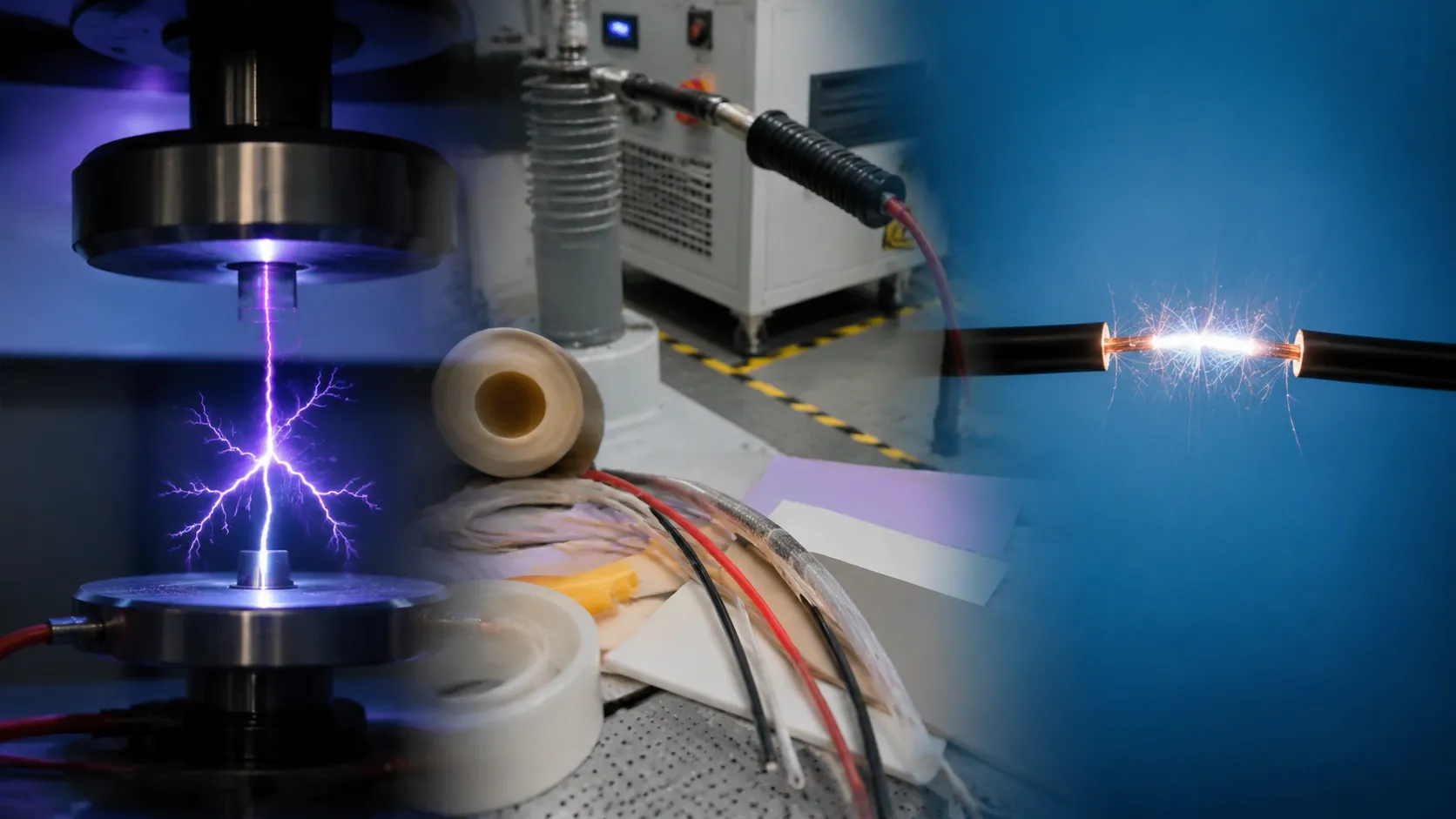
In high-voltage system design, the dielectric breakdown voltage is not a universal material constant—it is a test-condition-dependent failure threshold that engineers must verify against real operating conditions. Every insulating material, from transformer oil to battery pack separators, has a voltage limit beyond which it transitions from a reliable barrier to a conductive pathway. Misinterpreting this limit leads to field failures that no amount of safety margin can fully absorb.
This guide breaks down the physics, testing standards, and application-driven selection logic that technical buyers and design teams need to compare materials, specify tests, and avoid the insulation weaknesses that derail high-voltage projects. We focus on the underappreciated gap between theoretical dielectric strength and the actual breakdown voltage of a manufactured component—because that gap is where catastrophic faults take root.
What is Dielectric Breakdown Voltage?
Dielectric breakdown voltage is the minimum applied voltage at which an insulating material loses its resistive properties and permits a sudden, uncontrolled current surge, effectively transitioning from an insulator to a conductor.
The Transition from Insulator to Conductor
Under normal conditions, insulating materials hold bound electrons tightly within their atomic structures, preventing current flow. When the external electric field surpasses a critical threshold, the force acting on free or ionized charge carriers becomes sufficient to liberate additional electrons through impact ionization. These newly freed electrons accelerate and trigger further collisions, creating a self-sustaining cascade that drastically lowers the material’s resistance. The result is a localized or bulk conductive channel that permanently alters the insulation’s structure. In solids, this often leaves a carbonized puncture track; in liquids and gases, the breakdown may partially heal once voltage is removed, but the insulating properties are compromised.
Mathematical Representation of Breakdown Thresholds
The relationship between applied voltage and material thickness is often simplified as Vb = Eds × d, where Vb is breakdown voltage, Eds is the material’s theoretical dielectric strength, and d is the distance between electrodes. In practice, this linear relationship breaks down for thicker samples due to increased probability of internal defects, thermal instability, and non-uniform field distribution. For solid insulators thicker than a few millimeters, doubling the thickness yields less than double the breakdown voltage—a nonlinear scaling that invalidates naive safety margins. Engineers compensating for this effect often rely on empirical derating curves derived from standardized tests rather than simple proportional scaling.
Dielectric Breakdown Voltage vs. Dielectric Strength: Key Differences
The fundamental distinction is that dielectric breakdown voltage is a measured, component-specific failure point, expressed in volts or kilovolts, while dielectric strength is a material-level property, typically given in kV/mm or MV/m, representing the maximum electric field gradient the material can theoretically withstand under ideal lab conditions.
Absolute Voltage vs. Material Property
Dielectric strength is an intrinsic property tested on thin, homogeneous samples under carefully controlled electrode geometry and environmental conditions. It serves as a comparative material benchmark, not a design voltage rating. When a manufacturer stamps “20 kV/mm” on a datasheet, that number reflects a standard test, not the performance of a machined bushing with surface irregularities. The actual dielectric breakdown voltage of a finished component will always be lower because real parts contain microscopic voids, contamination, and geometric field enhancements. For technical specification reviews, both numbers must be requested: the material dielectric strength as a material screening metric, and the component breakdown voltage as an application qualifier.
The Non-Linear Effect of Material Thickness
Thicker insulation layers do not yield proportionally higher breakdown voltages due to what is essentially a statistical and thermal scaling problem. In a uniform field, the probability of encountering a critical defect—a void, a conductive particle, or a microcrack—increases with volume. Additionally, thick dielectrics develop internal temperature gradients under AC stress because dielectric heating scales with volume while conduction cooling scales with surface area. The resulting thermal runaway lowers the effective breakdown voltage below the simple product of thickness and dielectric strength. For designing for dielectric strength in custom pack insulation, engineers must apply thickness derating factors often found in IEC or ASTM application guides rather than relying on raw material strength values.
The Physical Mechanisms of Electrical Breakdown
Breakdown is not a single event but a chain of physical processes—electron multiplication, thermal runaway, and partial discharge erosion—that depend on material phase and defect structure.
Avalanche Breakdown (Townsend Discharge)
In gases and thin insulating films, the dominant breakdown mechanism is the Townsend avalanche. A free electron, accelerated over a mean free path, strikes a neutral atom with enough energy to ionize it, freeing a second electron. Both are then accelerated, and the generation rate grows exponentially along the field direction. This mechanism is characterized by the Townsend criterion: the exponential gain must exceed unity to sustain a self-propagating discharge. In practice, the presence of even minor protrusions on one electrode intensifies the local field, drastically reducing the voltage at which the avalanche reaches critical density. This sensitivity explains why ASTM standards for breakdown testing emphasize precisely defined electrode geometries and surface finishes.
Thermal Breakdown in Solid Dielectrics
Solids subjected to prolonged high voltage can fail thermally even when the applied field is well below the intrinsic dielectric strength. Dielectric losses due to polarization and leakage currents generate heat within the material. If the heat generation rate exceeds the heat dissipation capacity—a condition common in thick, thermally insulating layers or high-frequency applications—internal temperature rises. Because the material’s resistivity typically drops with temperature, a positive feedback loop develops, leading to a localized hot spot that eventually melts, chars, or carbonizes, forming a permanent conductive filament. Thermal management, therefore, is not just a reliability concern for battery cells; as outlined in our guide on thermal runaway and dielectric breakdown, it is a direct determinant of insulation longevity under electrical stress.
Partial Discharge and Corona Effects
Before a complete breakdown occurs, localized partial discharges (PD) often appear in gas-filled voids, delaminations, or surface contaminants within the insulation. Each PD event releases a small burst of energy that slowly erodes surrounding material, creates conductive carbon tracks, and expands the defect volume. Over months or years of operation, this incremental damage steadily reduces the dielectric breakdown voltage of the assembly until a full failure occurs at normal operating voltage. For battery systems, dielectric breakdown voltage testing that includes PD detection is becoming a standard requirement for high-voltage packs, particularly those exceeding 60 V DC where insulation failure poses direct safety hazards.
Key Factors Influencing Breakdown Voltage
The real-world dielectric breakdown voltage of any insulating system is not a fixed material attribute; it is suppressed—often dramatically—by temperature, moisture, electrode sharpness, and voltage waveform characteristics.
Temperature and Thermal Stress
Elevated temperature reduces breakdown voltage through two primary mechanisms: increased molecular mobility that facilitates ion transport, and accelerated thermal decomposition of organic insulators. For example, aged transformer paper at 110°C exhibits a significantly lower breakdown strength than new paper at 25°C, even before visible embrittlement appears. In battery pack design, where internal ambient temperatures can exceed 60°C during high-rate discharge, LiPo dielectric breakdown risks increase if insulation materials are not specifically selected for elevated-temperature hold-off capability. Designers should require breakdown voltage curves referenced to maximum expected service temperature, not just room-temperature datasheet values.
Moisture, Humidity, and Environmental Contaminants
Water absorption degrades dielectric properties because the water molecule’s high permittivity (≈80) and moderate conductivity create low-impedance micro-pathways. In fibrous insulators like pressboard, moisture greatly enhances surface tracking and bulk leakage. In transformer oil, as little as 30 ppm dissolved water can cut the breakdown voltage in half. This sensitivity is the reason that liquid dielectric testing standard ASTM D1816 is more moisture-sensitive than ASTM D877. For outdoor or unsealed industrial enclosures, condensation cycles and salt spray contamination drive a progressive reduction in standoff voltage that may not be captured by factory acceptance tests. Periodically evaluating insulation under expected humidity exposure is critical for utility maintenance managers.
Electrode Geometry and Field Uniformity
Sharp edges, burrs, or pointed electrode tips create localized electric field enhancement, concentrating stress at the tip to values several times larger than the average field. The field enhancement factor β at a sharp protrusion can exceed 100 for fine points, meaning a 10 kV average field produces a local stress of over 1000 kV/mm, instantly exceeding the dielectric strength of even high-performance ceramics. This is why standard test methods specify electrode dimensions precisely: uniform-field electrodes (Rogowski profile or plane-plane) give higher breakdown voltages than non-uniform needle-plane configurations. In real hardware, incomplete deburring of metal shims inside a lithium-ion pack insulation assembly can become exactly such an unintended enhancement site, causing partial discharge at voltages far below the design rating.
Voltage Frequency and Waveshape (AC, DC, Impulses)
The type of voltage stress matters. DC breakdown is largely determined by bulk resistivity and thermal behavior, whereas AC breakdown introduces additional capacitive coupling and dielectric heating losses that scale with frequency. At 50/60 Hz power frequencies, these differences are moderate, but in high-frequency switching circuits or inverter outputs, the dielectric strength may drop significantly. Lightning impulse testing (1.2/50 µs waveform) probes a material’s tolerance to extremely fast overvoltage spikes; many materials that survive a 1-minute AC hipot test will fail under a much lower-amplitude impulse because the stress timescale does not permit thermal relaxation. When specifying breakdown voltage requirements, it is important to include the intended test waveform: AC, DC, or standard impulse.
Dielectric Properties of Common Insulating Materials
No single insulating material dominates; selection depends on the trade-off between dielectric strength, thermal class, mechanical toughness, and cost. Below is a comparative reference for industrial-grade insulators used in transformers, cables, and high-voltage battery systems.
| Material Class | Common Example | Typical Dielectric Strength (kV/mm) | Primary Breakdown Mechanism | Key Industrial Use Case |
|---|---|---|---|---|
| Gaseous | Air (dry, at standard pressure) | ~3 | Townsend avalanche, streamer | Line-to-ground clearance design; switchgear arc-quenching |
| Gaseous | SF₆ (sulfur hexafluoride) | ~8.5 (at 0.3 MPa) | Electron attachment and inhibition, thermal re-ignition under arcing | Gas-insulated substations (GIS); high-voltage circuit breakers |
| Liquid | Mineral Transformer Oil (new, dry) | ~12-16 (ASTM D1816) | Streamer propagation through particle bridges and moisture | Power transformer insulation and cooling; oil-immersed switches |
| Liquid | Synthetic Ester (e.g., MIDEL 7131) | ~16-20 | Streamer initiated at electrode liquid interface; high moisture tolerance | Distribution transformers where fire safety and biodegradability are critical |
| Solid | Alumina Ceramic (Al₂O₃, 96%) | ~12-15 | Thermal punching; grain boundary melting | High-frequency insulators; semiconductor processing stands |
| Solid | PTFE (Teflon) | ~18-20 (thin film) | Thermal softening and flashover, tracking under contamination | High-frequency coax spacers; chemically aggressive environments |
| Solid | Electrical Grade Paper (Kraft, dry) | ~5-10 (thickness dependent) | Fibril erosion from partial discharge; thermal aging | Layer insulation in oil-filled transformers; bushing cores |
Note: Typical dielectric strength values are for laboratory-condition samples (thin, clean, dry) and will be lower in finished components. All values should be verified with the material supplier under actual service conditions and test protocols.
Testing Standards and Destructive Procedures
Confirming a material’s dielectric breakdown voltage requires adherence to internationally recognized test methods that control electrodes, voltage rise rates, and sample conditioning to ensure repeatable results.
ASTM D149: Standard Test Method for Solid Insulators
ASTM D149 is the primary standard for measuring dielectric breakdown voltage and dielectric strength of solid electrical insulating materials at power frequencies (typically 60 Hz). It defines two procedures: the short-time test, where voltage is ramped at a uniform rate until failure, and the step-by-step test, which evaluates endurance under prolonged stress. Electrode configuration is tightly specified—flat metal electrodes of defined diameter with smooth, radiused edges—to minimize field enhancement. Sample preparation dictates temperature and humidity conditioning, as even a few hours of ambient lab humidity can bias results downward. For accurate comparison between suppliers, specifiers should request breakdown values per ASTM D149 with specified electrode type and conditioning protocol.
ASTM D877 vs. ASTM D1816: Liquid Dielectrics and Transformer Oils
For insulating liquids, the two most cited methods serve different purposes. ASTM D877 uses flat 1-inch diameter disc electrodes with a 2.54 mm gap. It is relatively insensitive to small amounts of moisture and particulate contamination, making it useful for routine quality control of new, clean oil but insufficient for field-aged fluid evaluation. ASTM D1816 replaces flat discs with spherically-capped electrodes (typically VDE electrodes), increasing field uniformity at the measurement zone. This geometry is far more sensitive to dissolved water and cellulose fiber contamination—a single water droplet near saturation can drop the measured breakdown voltage from 40 kV to under 15 kV. Maintenance engineers interpreting oil test reports must know which standard was applied: an acceptable D877 result does not guarantee acceptable D1816 performance. Many utility specifications now mandate D1816 for condition assessment, while D877 remains a pass/fill acceptance check.
Destructive vs. Non-Destructive Testing Protocols
To determine the exact dielectric breakdown voltage, one must drive the sample to failure—making the test inherently destructive. This is the case for both solid puncture testing (ASTM D149) and liquid breakdown (D877/D1816) where the dielectric gap is intentionally overloaded. In contrast, production-line hipot testing is a non-destructive proof test: a voltage higher than the rated service voltage but below the expected breakdown threshold is applied for a specified duration. If the device withstands without flashover or excessive leakage, it passes. Hipot testing does not measure breakdown voltage; it certifies that a given sample tolerates a predetermined overvoltage. Both methods are essential: destructive characterization during design qualification, and non-destructive proof testing during manufacturing. Battery management systems, for example, often incorporate BMS insulation monitoring that acts as continuous, low-energy hipot surveillance, preventing operation when cell imbalance and dielectric stress degrade isolation thresholds below safety margins.
Industrial Applications: Material Insulation in Practice
From subsea HVDC cables to utility worker personal protective equipment, the real-world selection and monitoring of dielectric breakdown voltage defines system reliability and workforce safety.
High-Voltage Transformer Maintenance and Oil Diagnostics
Power transformers contain thousands of liters of mineral oil serving as both coolant and high-voltage insulation. Over decades of service, cellulose paper decomposition, moisture ingress, and thermal cycling increase the oil’s particulate and water content. Routine testing of oil samples per ASTM D1816 provides a sensitive indicator of insulation health: a declining breakdown voltage trend often precedes catastrophic winding failure. Maintenance managers correlate oil dielectric breakdown results with dissolved gas analysis (DGA) and degree of polymerization (DP) of paper samples to schedule proactive reconditioning or replacement. A sudden drop in dielectric strength may also indicate a contaminated tap-changer compartment or a leak that introduced external moisture, triggering immediate corrective action.
Power Cable Insulation and Solid Dielectrics
Extruded cross-linked polyethylene (XLPE) and ethylene propylene rubber (EPR) cables rely on void-free insulation manufacturing to meet dielectric breakdown voltage thresholds of several hundred kV for transmission-class cables. In cable qualification, partial discharge testing at 1.73 × U₀ (phase-to-ground voltage) is mandatory before voltage endurance tests push insulation to failure. For medium-voltage distribution cables, service-aged samples extracted from the field often exhibit water trees—dendritic micro-void structures that grow under combined electric stress and moisture—that reduce breakdown strength to a fraction of the original specification. Asset managers select replacement cable specifications based on wet-aging performance, not merely dry-type test values.
Field Safety Applications: The Dielectric Rating of Wasp Sprays
A less obvious but practical industrial use of dielectric breakdown voltage appears in the cans of aerosol insecticide carried by utility line crews. Workers treating wasp nests on live power poles need assurance that the spray stream will not conduct electricity back to them. Specialty dielectric wasp sprays are formulated to achieve a dielectric breakdown voltage exceeding 40 kV when sprayed from a typical 12-inch distance, preventing the fluid stream from becoming a conductive path from a 12 kV or 15 kV line to the grounded worker. The rating is verified under standardized wet-arc test conditions, not simply the bulk liquid’s dielectric strength, because the atomized spray pattern and stream coherence affect real-world hold-off. This application is a vivid reminder that breakdown voltage is a systems-level metric, not just a material property.
Partnering with Material Characterization and High-Voltage Labs
Confirming that insulation designs meet their required dielectric breakdown voltage levels under worst-case operating conditions is not a task for generic test benches—it demands specialized high-voltage laboratories, calibrated electrodes, and testing protocols aligned with real application stress profiles.
When specifying breakdown voltage for a new battery module or custom pack, we recommend looking beyond raw material datasheets. Verify that the chosen testing partner offers ISO/IEC 17025 accreditation, experience with your voltage class, and capabilities for thermal-humidity pre-conditioning and partial discharge mapping. The difference between a standardized D149 test at room temperature and a combined temperature/humidity step stress test can be the difference between a design that passes factory acceptance and one that fails months later in the field.
Our engineering team works with clients to define the appropriate dielectric testing protocols for custom manufacturer dielectric specs and integrate UN38.3 dielectric test requirements into the development cycle. For assistance with insulation material selection, breakdown voltage testing, or to discuss how to specify dielectric performance for your next project, reach out to our application engineers. We can help you move from theoretical dielectric strength tables to validated, field-ready insulation performance.
Frequently Asked Questions
What is a “good” dielectric breakdown voltage?
A “good” value is entirely application-dependent. Dry air at a 1 mm gap breaks down around 3 kV, which is adequate for low-voltage PCB spacing but disastrous for a 15 kV power distribution bushing. High-voltage cable insulation, on the other hand, must withstand over 50 kV/mm. Context drives the target; always benchmark against accepted industry practice for the specific equipment class and voltage level.
How does moisture affect dielectric breakdown voltage?
Water, with its high permittivity and moderate conductivity, forms low-resistance channels through and across insulating surfaces. Even trace moisture absorbed by pressboard or suspended in oil significantly concentrates the electric field, lowering the voltage at which streamers initiate. This is why liquid dielectric tests (ASTM D1816) require dry, filtered samples to reflect true contamination effects.
Is dielectric breakdown voltage testing always destructive?
Yes—determining the exact breakdown voltage requires ramping the voltage until failure, permanently damaging the sample. However, production hipot testing is non-destructive because it simply verifies that the insulation can hold a specified test voltage without failing; it does not measure the actual limit.
Why does electrode shape matter during testing?
Sharp edges concentrate the electric field locally, creating a field enhancement factor that can initiate breakdown at a much lower voltage than flat or spherical electrodes. For reliable comparison, test standards prescribe electrode geometries that minimize unintended field concentration, ensuring the measured breakdown voltage reflects the material, not the test fixture.
Frequently Asked Questions

Get a Fast, Custom Power Quote


 English
  Turkish
  Arabic